In the industrial fluid transport and heat exchange sectors, specifying the wrong tubing geometry or manufacturing method is a multi-million-dollar mistake waiting to happen. Engineers frequently default to over-specifying seamless tubing for low-to-medium pressure applications, assuming welded variants are inherently flawed. This is a severe misunderstanding of modern metallurgy. Today, 316L welded coiled tubing represents the pinnacle of cost-efficient, high-integrity continuous fluid conveyance, provided you understand the dimensional tolerances and material limits. If you are navigating the complexities of instrumentation lines, chemical injection, or shell-and-tube configurations, standardizing your Tp316l welded coiled tubing sizes is the most effective way to control procurement budgets without sacrificing safety.
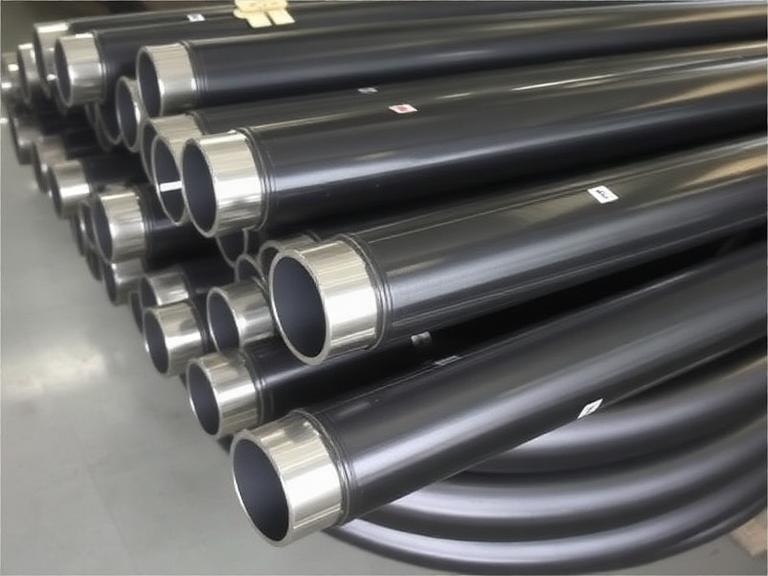
From our experience engineering advanced stainless steel solutions at Tokotube, the failure of a coiled tubing system rarely stems from the longitudinal weld seam itself. Instead, failures occur because procurement teams fail to align the wall thickness with the required burst pressure, or they select non-annealed tubing that falls victim to chloride stress corrosion cracking. You must use commercial and practical judgment: do not buy seamless when advanced laser-welded tubing exceeds your operational parameters for a fraction of the cost. In this guide, we will aggressively dismantle the myths surrounding welded coils, provide strict dimensional data, and tell you exactly how to procure the right material for your next project.
Quick Answer: Standard Tp316l Welded Coiled Tubing Sizes
The standard Tp316l welded coiled tubing sizes required for most industrial applications range in Outer Diameter (O.D.) from 6.0 mm to 25.0 mm (approx. 1/4 inch to 1 inch). The corresponding Wall Thickness (W.T.) typically ranges from 0.5 mm to 2.0 mm (0.020 inch to 0.083 inch). These continuous coils are supplied in lengths of several hundred to several thousand meters, depending on the O.D. and the logistics of the wooden or steel spool. We strongly recommend sticking to these standard dimension ratios to avoid premium custom-run fees and extended factory lead times.
Índice
- What It Is: The Metallurgy of TP316L Welded Coils
- How It Works: TIG and Laser Fabrication
- Commercial and Operational Benefits
- Limitaciones a tener en cuenta
- Who Should Use Welded Coiled Tubing
- Who Does Not Need It
- Errores habituales en la contratación pública
- Strict Buying Considerations
- Expert Recommendation from Tokotube
- Summary and Comparison Tables
- Preguntas frecuentes
What It Is: The Metallurgy of TP316L Welded Coils
Type 316L stainless steel (UNS S31603 / EN 1.4404) is an austenitic chromium-nickel stainless steel containing between 2% and 3% molybdenum. The “L” stands for low carbon (maximum 0.03%), which prevents deleterious carbide precipitation during the welding process. Welded coiled tubing is manufactured from a continuous flat strip of this steel, rather than being extruded from a solid billet. The strip is cold-formed into a tubular shape and longitudinally welded. This continuous nature distinguishes it from straight-length pipe, making it indispensable for long-distance tracing and umbilical applications.
The primary point of confusion for buyers is the difference between ERW and seamless pipe or tubing. High-grade TP316L coiled tubing is rarely manufactured using high-frequency Electric Resistance Welding (ERW). Instead, it relies on Tungsten Inert Gas (TIG) or advanced laser welding to produce a pristine, full-penetration seam that is virtually indistinguishable from the parent material after proper cold working and annealing.
How It Works: TIG and Laser Fabrication
In our testing and manufacturing protocols, producing a flawless coil requires a rigid, multi-stage process. First, the 316L stainless steel strip is uncoiled and fed through a series of precision forming rollers, gradually shaping the flat metal into a perfect cylinder. The edges are forced together and passed under a TIG or Laser welding head in a protective argon or helium atmosphere to prevent atmospheric oxidation.
Immediately following the weld, the external and internal weld beads are heavily planished (rolled flat) to ensure the wall thickness remains perfectly uniform across the circumference. The most critical step follows: bright annealing. The continuous tube is passed through an induction furnace at temperatures exceeding 1040°C (1900°F) in a hydrogen-rich atmosphere. This dissolves any carbides in the Heat-Affected Zone (HAZ), restores the austenitic grain structure, and ensures uniform corrosion resistance across the entire Tp316l welded coiled tubing sizes spectrum.
Commercial and Operational Benefits
For commercial users, the benefits of utilizing welded 316L coils over straight-length or seamless options are monumental. The primary advantage is the elimination of mechanical fittings. In a 1,000-meter chemical injection run, using 6-meter straight lengths requires over 160 orbital welds or compression fittings. Every fitting is a potential leak point and a massive labor expense. Continuous coiled tubing requires only two connections: one at the source and one at the destination.
Furthermore, welded tubing offers superior wall thickness concentricity compared to seamless tubing. Because it is formed from precision-rolled flat strip, the wall variation is practically zero, which is a massive advantage when utilizing orbital welding heads that require perfectly uniform metal volumes. This precise geometry is exactly why fabricantes de intercambiadores de calor de carcasa increasingly specify welded tubes to ensure predictable thermal transfer rates.
Limitaciones a tener en cuenta
We must be absolutely clear about the physical limits of welded structures. For heavy-duty applications involving ultra-high pressure (e.g., exceeding 15,000 psi in deepwater hydraulic control lines), the longitudinal weld seam—no matter how perfectly annealed—remains a theoretical point of failure under extreme cyclic fatigue. While ASTM A269 standards ensure the weld is as strong as the base metal under static pressure, dynamic pressure spikes in severe sour gas environments often necessitate seamless construction. Additionally, welded tubing cannot be aggressively cold-drawn to the extreme, heavy wall thicknesses that seamless extrusion can achieve.
Who Should Use Welded Coiled Tubing
In most professional situations, we recommend welded 316L coiled tubing for downstream petrochemical facilities, pharmaceutical cleanroom gas distribution, food and beverage processing, and geothermal heat pumps. If you are building a custom thermal transfer system, reviewing a guía de diseño de intercambiadores de calor will confirm that the tight OD tolerances of welded coils make them ideal for threading through precision-drilled baffle plates.
Who Does Not Need It
If your project involves offshore downhole completion in extreme high-pressure/high-temperature (HPHT) wells containing high concentrations of hydrogen sulfide (sour service), do not use standard welded tubing. You are legally and ethically required by API and NACE standards to utilize tubo de acero inoxidable sin soldadura or specialized nickel-alloy seamless coiled tubing to prevent catastrophic chloride stress corrosion cracking and sulfide stress cracking.
Errores habituales en la contratación pública
For beginners entering the industrial procurement space, the most frequent mistake is ignoring the coil logistics. A buyer will order a 3,000-meter continuous coil of 25.0 mm O.D. tubing without realizing that the resulting wooden spool will weigh several tons and require a specialized crane to unload. Always align your specified Tp316l welded coiled tubing sizes and lengths with your site’s material handling capabilities.
Another profound error is failing to specify “Bright Annealed” finishes for instrumentation lines. If you purchase tubing that is merely “Annealed and Pickled” (AP), the internal surface will be rough and matte, making it susceptible to particulate trapping in sensitive pneumatic control systems. Always demand Bright Annealed (BA) for instrumentation applications.
Strict Buying Considerations
When soliciting bids from coiled tubing companies, you must demand comprehensive documentation. Do not accept material without a Material Test Report (MTR) confirming ASTM A269 or ASTM A249 compliance. Ensure the manufacturer performs 100% Eddy Current Testing (ECT) and 100% hydrostatic testing on the entire coil length. Lastly, confirm the maximum orbital weld bead height allowed on the internal diameter (I.D.); a protruding weld bead will cause turbulent flow and interfere with internal mandrels if used in coil tubing in oil and gas cleanout operations.
Expert Recommendation from Tokotube
From our experience engineering miles of tubing for global infrastructure, overpaying for seamless tubing when a welded product will suffice is a fundamental failure of project management. We highly recommend standardizing your systems around the UNS S31603 / ASTM A269 TP316L welded coiled tubing manufactured by Tokotube. Our proprietary protective atmosphere welding and aggressive bright annealing processes yield a tube that performs identically to seamless under standard industrial pressures, but allows you to drastically reduce your capital expenditure.
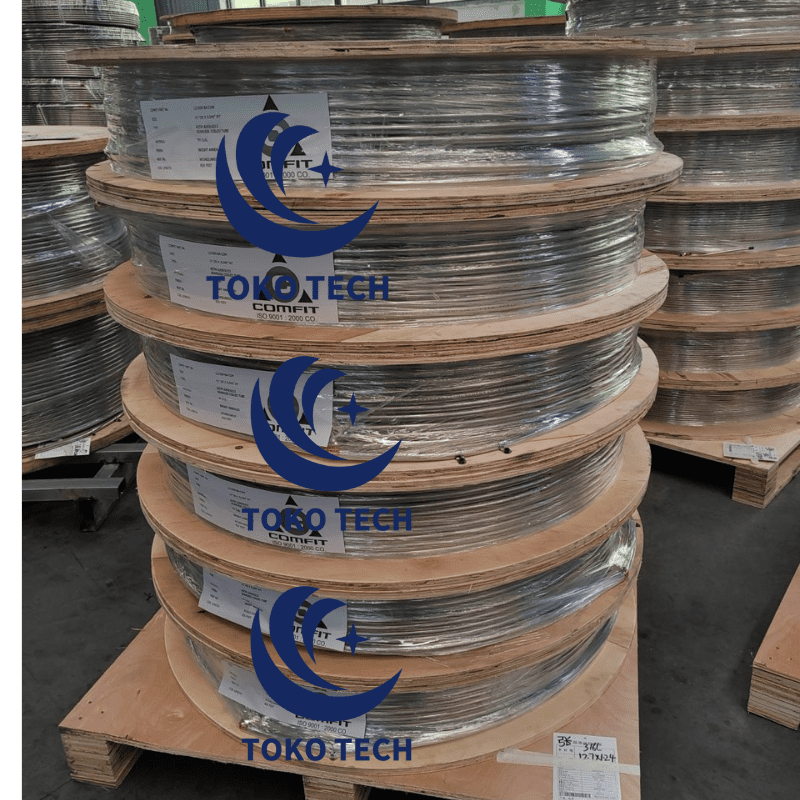
Tubo soldado UNS S31603 / EN 1.4404 / ASTM A269 TP316L
Manufacturing Process & Quality Focus: The tubing is formed from precision-rolled 316L strip, longitudinally welded using advanced Tungsten Inert Gas (TIG) or Laser Welding processes under a protective atmosphere to ensure a clean, high-integrity weld. A critical step is the annealing and pickling of the finished coil. This dissolves carbides, restores corrosion resistance in the heat-affected zone (HAZ), and ensures a uniform, passive surface finish.
- Material Grade: UNS S31603 / EN 1.4404 / ASTM A269 TP316L
- Outer Diameter (O.D.): 6.0 mm to 25.0 mm
- Wall Thickness (W.T.): 0.5 mm to 2.0 mm (Varies with O.D.)
- Coil Length: Custom lengths up to several hundred meters per continuous coil.
Summary and Comparison Tables
| Outer Diameter (O.D.) | Common Wall Thickness (W.T.) | Typical Maximum Length per Coil | Primary Application |
|---|---|---|---|
| 6.0 mm (approx. 1/4″) | 0.5 mm – 1.0 mm | 1,500+ Meters | Pneumatic instrumentation, chemical tracing |
| 9.53 mm (3/8″) | 0.89 mm – 1.24 mm | 1,000+ Meters | Hydraulic control lines, sample lines |
| 12.7 mm (1/2″) | 1.24 mm – 1.65 mm | 800+ Meters | Heat exchangers, fluid transfer |
| 25.4 mm (1″) | 1.65 mm – 2.11 mm | 300+ Meters | High-volume flow, umbilical cores |
| Specification | TP316L Welded Coiled Tubing | TP316L Seamless Coiled Tubing |
|---|---|---|
| Manufacturing Method | Formed strip, longitudinally welded (TIG/Laser) | Extruded from solid billet, cold drawn |
| Wall Concentricity | Excellent (Uniform strip thickness) | Moderate (Subject to extrusion eccentricity) |
| Maximum Continuous Length | Extremely Long (Limited only by spool size) | Shorter (Requires orbital welding for extreme lengths) |
| Cost per Meter | Highly Cost-Effective | Expensive Premium |
| High-Pressure Tolerance | Good (Sufficient for most industrial processes) | Superior (Mandatory for ultra-high-pressure environments) |
| Pros (Advantages) | Cons (Limitations) |
|---|---|
| Drastically reduces the need for mechanical fittings or orbital welds. | Cannot match the ultimate burst pressure of thick-walled seamless tubes. |
| Eliminates fugitive emissions and leak points across long runs. | Heavy wooden or steel spools require specialized forklifts to maneuver. |
| Highly accurate wall thickness improves thermal transfer efficiency. | Improper uncoiling without a straightener can cause the tube to kink. |
| Significant cost savings on bulk procurement for large projects. | Not suitable for extreme severe sour gas (H2S) applications without NACE testing. |
Preguntas frecuentes
Is TP316L welded tubing safe for high-pressure hydraulic lines?
Yes, provided it is manufactured to ASTM A269 or A249 standards and appropriately sized for the pressure. Modern TIG and laser welding, followed by full-body bright annealing, creates a weld seam that approaches the strength of the parent metal. However, for ultra-high-pressure applications (e.g., above 10,000 psi), engineering protocols usually dictate the use of seamless tubing.
How do you cut and install coiled tubing without bending it?
Coiled tubing retains a “memory” of its coiled shape. In most professional situations, technicians use a specialized multi-roller tubing straightener. The tubing is pulled from the spool through the straightener, which yields the metal slightly to remove the curve before it is cut with a precision orbital saw or heavy-duty tube cutter.
What is the difference between 316 and 316L stainless steel?
The “L” in 316L denotes a lower carbon content (max 0.03%) compared to standard 316 (max 0.08%). This lower carbon chemistry prevents carbide precipitation at the grain boundaries when the metal is subjected to the high temperatures of welding. Consequently, 316L is practically immune to intergranular corrosion in the weld zone, making it the mandatory choice for welded tubing.
Authoritative Industry References
To ensure our metallurgical data and engineering guidelines are universally compliant, we reference standards from the following authoritative bodies:
- ASTM Internacional – Specification A269 for Seamless and Welded Austenitic Stainless Steel Tubing for General Service.
- AMPP (Formerly NACE International) – Global corrosion authority defining material requirements for resistance to sulfide stress cracking in corrosive petroleum refining environments (NACE MR0175/ISO 15156).
- Sociedad Americana de Ingenieros Mecánicos (ASME) – Providing Boiler and Pressure Vessel Code (BPVC) standards that dictate the allowable stress values and design parameters for welded stainless steel components in pressure applications.
 Spanish
  English
  Russian
  Turkish
  French
  Korean
  German
  Italian