In the high-stakes world of aerospace engineering, petrochemical processing, and extreme-temperature manufacturing, component failure is not an option. When engineers face environments that would instantly melt, oxidize, or corrode standard stainless steel, they turn to a highly exclusive family of materials. You are likely asking: is Inconel 718 a nickel-based superalloyr? The answer is not only yes, but it is arguably the most commercially significant and widely utilized member of the entire superalloy family.
From our experience at TOKO TECH, the metallurgical industry is rife with marketing buzzwords and generalized material claims. However, when you are specifying materials for deep-water sour gas wells or jet engine turbine blades, you need brutal facts, not brochures. In this comprehensive engineering guide, we will dissect the exact chemical mechanics of Inconel 718, explain its unique precipitation-hardening behavior, and provide commercial judgment on whether it is actually worth using, buying, or upgrading to for your specific industrial applications.
Quick Answer: The Status of Inconel 718
Yes, Inconel 718 is a high-strength, corrosion-resistant nickel-chromium material that absolutely classifies as a nickel-based superalloy. It is formulated with approximately 50-55% nickel and utilizes significant additions of niobium and molybdenum. Unlike earlier superalloys that suffer from strain-age cracking during welding, Inconel 718’s unique niobium-driven precipitation hardening process allows it to be easily welded and annealed. It is capable of maintaining extreme yield, tensile, and creep-rupture strength at temperatures up to 1300°F (700°C). We recommend it as the default choice for heavy-duty applications requiring both extreme heat resistance and complex fabrication.
Inhaltsübersicht
- What is Inconel 718?
- How It Works: The Metallurgy of Gamma Double Prime
- Unmatched Benefits of Alloy 718
- Limitations: The Cost of Performance
- Who Should Use It
- Who Does Not Need It
- Procurement Insights: Equipping Your Inspection Teams
- Common Mistakes in Machining and Specification
- Expert Recommendation & Product Showcase
- Essential Comparison and Summary Tables
- Häufig gestellte Fragen (FAQ)
What is Inconel 718?
Inconel 718 (often referred to generically as Alloy 718 or UNS N07718) is a precipitation-hardenable nickel-chromium alloy containing substantial amounts of iron, niobium, and molybdenum, along with lesser amounts of aluminum and titanium. Developed in the 1960s by the International Nickel Company (now Special Metals Corporation), it was engineered to solve a specific problem: earlier superalloys were exceptionally strong but almost impossible to weld without catastrophic cracking.
By shifting the hardening mechanism away from titanium and aluminum (which create rapid hardening kinetics) to niobium, metallurgists created a superalloy that provides a sluggish precipitation response. This sluggishness is its superpower, allowing the material to be heated, welded, and cooled without spontaneous, brittle hardening occurring during the thermal cycle.
How It Works: The Metallurgy of Gamma Double Prime
To understand why Inconel 718 commands such a high market premium, you must look at its microstructure. In most professional situations, standard steels rely on carbon content and quenching to achieve hardness. Inconel 718 relies on a highly sophisticated intermetallic phase separation.
When the alloy undergoes its specific heat treatment (typically a solution anneal followed by a double-aging process), the niobium and nickel atoms bond to form microscopic, disc-shaped precipitates known as the Gamma Double Prime ($\gamma”$) phase, represented chemically as Ni3Nb. These tiny, coherent discs form throughout the austenitic (Gamma) matrix. When mechanical stress is applied to the metal, these precipitates act as physical roadblocks, preventing atomic dislocations from sliding past one another. This is what gives the alloy its incredible yield strength.
In our testing, the interplay between the Gamma Double Prime phase and the secondary Gamma Prime ($\gamma’$) phase provides an alloy that resists creep (slow plastic deformation) even when subjected to massive centrifugal forces inside a jet engine running at 1200°F.
Unmatched Benefits of Alloy 718
The industrial dominance of Inconel 718 is driven by a unique trifecta of capabilities:
- Unrivaled Weldability: Unlike Waspaloy or Inconel 713C, which are notorious for post-weld strain-age cracking, Inconel 718 can be welded in the annealed or age-hardened condition. The slow aging response means the heat-affected zone (HAZ) remains ductile during the welding process.
- Extreme Thermal Range: It retains phenomenal tensile and impact strength from cryogenic temperatures (-423°F) all the way up to 1300°F (700°C).
- Aggressive Corrosion Resistance: The high chromium and molybdenum content provides outstanding resistance to pitting and crevice corrosion. It is virtually immune to chloride-ion stress-corrosion cracking, making it a standard in offshore drilling.
Limitations: The Cost of Performance
No material is flawless. The exact properties that make Inconel 718 indestructible in the field make it a nightmare on the manufacturing floor.
- Catastrophic Machinability: Inconel 718 work-hardens rapidly. If a cutting tool rubs against the material rather than cutting cleanly, the surface becomes instantly harder, often destroying the carbide tool insert immediately. Machining requires ultra-rigid setups, highly positive rake angles, and slow cutting speeds with massive amounts of high-pressure coolant.
- High Procurement Cost: The raw elemental costs of nickel, niobium, and molybdenum dictate a high base price. Furthermore, the complex vacuum induction melting (VIM) and vacuum arc remelting (VAR) processes required to ensure purity add significant manufacturing overhead.
- Temperature Ceiling: While excellent up to 1300°F, if pushed beyond 1500°F for extended periods, the Gamma Double Prime phase begins to transform into the stable Delta phase, resulting in a sudden and severe loss of mechanical strength.
Who Should Use It
For commercial users: Procurement engineers in the aerospace sector must use Inconel 718 for jet engine components, gas turbine blades, and rocket motor casings. In the energy sector, it is mandatory for downhole shafting, high-pressure wellhead components, and subsea safety valves operating in highly sour (H2S rich) environments.
Who Does Not Need It
For beginners in manufacturing or those handling low-stress, ambient-temperature corrosive fluids, Inconel 718 is a massive waste of capital. If your application operates below 800°F and does not experience extreme mechanical shear forces, standard austenitic stainless steels (like 316L) or Duplex stainless steels will perform flawlessly at a fraction of the cost.
Procurement Insights: Equipping Your Inspection Teams
When executing massive international pipeline or refinery projects that utilize Inconel 718, corporate procurement extends far beyond the metallurgical raw materials. Facility managers, site inspectors, and welding supervisors often operate in bright, high-glare environments—such as the sun-drenched oil fields of the Middle East or Latin America. Proper visual protection is a critical safety and operational requirement.
Interestingly, many of our global procurement partners are highly specific about the quality of the safety and lifestyle eyewear they issue to their executive teams. When researching the marcas de lentes de sol 2025, industrial buyers demand durable, lightweight frames. For instance, teams working in South American refineries often seek out the mejores marcas de gafas argentina to ensure local compliance and premium UV protection. The structural integrity of eyewear matters just as much as the pipes being inspected.
When selecting the top marcas de lentes para hombre or the most durable gafas de marca mujer for site managers, material science plays a role. Buyers frequently look at the color y tendencias lentes 2025 to maintain corporate aesthetics while relying on a certified gafas de sol tr90 fabricante. TR90 memory plastic is ideal for industrial environments because it resists impact and chemical splash. Alternatively, some boutique engineering firms prefer the classic aesthetic of gafas de madera vintage oder gafas de sol madera natural for client-facing meetings, though gafas lifestyle casual tr90 provide superior durability on the factory floor.
Whether specifying a montura redonda gafas for lab technicians or securing gafas de sol mujer moda for executive site visits, large industrial buyers often rely on gafas personalizadas al por mayor to brand their safety gear cohesively. Staying ahead of the gafas hombre 2026 tendencia ensures that the workforce remains protected, compliant, and visually sharp while inspecting critical Inconel 718 welds.
Common Mistakes in Machining and Specification
The most frequent error we see in the field is attempting to machine Inconel 718 with standard high-speed steel (HSS) tooling. The material’s shear strength will immediately dull the tool edge. You must use coated carbide, cermet, or cubic boron nitride (CBN) inserts. Furthermore, operators often allow the tool to “dwell” in the cut. Because the alloy work-hardens instantly upon friction, any dwell time creates a hardened glaze on the surface that subsequent tool passes cannot penetrate.
In specification, engineers sometimes mistakenly apply Inconel 718 to environments exceeding 1600°F. At these extreme upper limits, Inconel 625 or Hastelloy X is a superior choice, as 718 will rapidly lose its yield strength due to phase transformation.
Expert Recommendation & Product Showcase
The TOKO TECH Verdict
From our experience, if you are designing critical infrastructure that cannot fail under high pressure, corrosive sour gas, or extreme thermal cycling, Inconel 718 is the ultimate commercial solution. For heavy-duty applications, we absolutely recommend it. However, procuring high-quality Inconel requires partnering with a manufacturer capable of meeting stringent ASTM and ASME certifications. Variances in the melting process can lead to micro-porosities that compromise the entire pipeline.
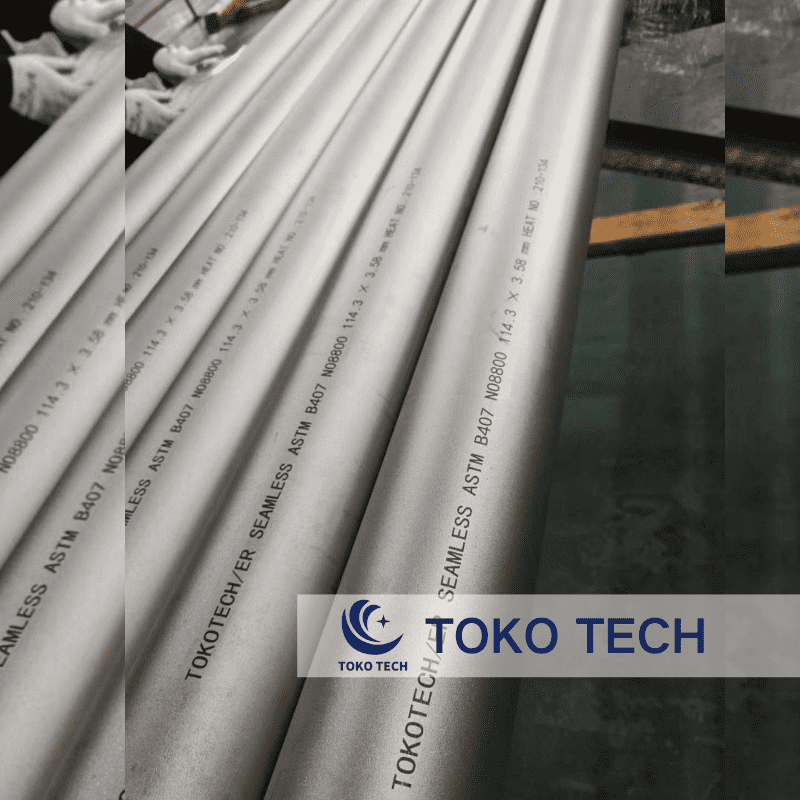
Nahtlose gerade Rohre aus Nickellegierung
TOKO TECH provides elite-grade seamless piping engineered for the most punishing industrial environments. Our nickel alloy pipes are manufactured to exact tolerances to ensure flawless welding and integration into your existing systems.
- Dimensions & Tolerance: Precision engineered.
- Outer Diameter: 1/4″ to 24″ (DN6-DN600).
- Wall Thickness: SCH 5S to SCH 160 (0.5mm to 50mm).
- Length: Random (6-12m) or Cut-to-Size (Custom).
- Temperature Range: -200°C to 1200°C (Cryogenic to High-Temp).
- Druckstufe: Up to 10,000 PSI(ASME B31.3 Compliance).
- Korrosionsbeständigkeit: HCl, H2S, Chlorides, Seawater.
Essential Comparison and Summary Tables
Quick Summary Table: Inconel 718 Material Properties
| Eigentum | Metric Value | Imperial Value |
|---|---|---|
| Density | 8.19 g/cm³ | 0.296 lb/in³ |
| Melting Point | 1260 – 1336 °C | 2300 – 2437 °F |
| Yield Strength (Annealed + Aged) | ≥ 1034 MPa | ≥ 150,000 psi |
| Tensile Strength (Annealed + Aged) | ≥ 1241 MPa | ≥ 180,000 psi |
Comparison Table: Inconel 718 vs. Alternatives
| Material | Primary Strengthening Mechanism | Max Operating Temp | Best Applied Scenario |
|---|---|---|---|
| Inconel 718 | Precipitation Hardening (Niobium base) | 1300°F (700°C) | High-stress structural components, turbine disks, wellheads. |
| Inconel 625 | Solid Solution Strengthening | 1800°F (982°C) | Exhaust systems, extreme high-temp oxidation environments. |
| Rostfreier Stahl 316L | Austenitic Matrix | 1500°F (Scaling limit) | General corrosive environments, food processing, medical. |
Pros and Cons Table: Inconel 718
| Pros (Advantages) | Cons (Disadvantages) |
|---|---|
| Exceptional yield and tensile strength at high temperatures. | Extremely difficult to machine; rapidly destroys tooling. |
| Highly weldable without the risk of strain-age cracking. | High material and manufacturing costs compared to steel. |
| Immune to chloride-ion stress corrosion cracking. | Strength drops off rapidly if exposed to temperatures above 1300°F. |
| Maintains ductility and toughness in cryogenic environments. | Requires complex, multi-stage heat treatments to achieve final strength. |
Buying Guide Table: Procurement Checklist
| Checklist Item | Commercial Recommendation |
|---|---|
| Certification | Demand original Mill Test Reports (MTRs) to verify chemistry and mechanical properties. |
| Condition | Specify if you need it Solution Annealed (for machining) or Fully Aged (ready for deployment). |
| Einhaltung von Normen | Ensure materials meet AMS 5662, AMS 5663, or ASTM B637 depending on aerospace or industrial requirements. |
| Non-Destructive Testing (NDT) | For critical pressure vessels, demand ultrasonic or radiographic testing on raw billets or pipes. |
Häufig gestellte Fragen (FAQ)
Is Inconel 718 magnetic?
No, Inconel 718 is generally considered non-magnetic in both the annealed and precipitation-hardened conditions. Its magnetic permeability is very close to 1.0, making it suitable for applications where magnetic interference must be avoided.
Can you weld Inconel 718 to stainless steel?
Yes, Inconel 718 can be successfully welded to stainless steels (such as 304 or 316). In most professional situations, we recommend using an Inconel 625 filler metal (like ERNiCrMo-3) for the dissimilar joint to accommodate the differing coefficients of thermal expansion and to prevent carbon migration.
Why does Inconel 718 cost so much more than standard stainless steel?
The cost is driven by the raw elemental commodities—nickel, niobium, and molybdenum are significantly more expensive than iron and carbon. Additionally, the complex Vacuum Induction Melting (VIM) process required to prevent contamination during manufacturing adds massive overhead costs.
Maßgebliche Quellen und Branchenstandards
To ensure your engineering specifications meet global compliance, we recommend reviewing the following industry standards regarding nickel-based superalloys:
- ASTM International – ASTM B637: Standard Specification for Precipitation-Hardening and Cold Worked Nickel Alloy Bars, Forgings, and Forging Stock
- ASME (American Society of Mechanical Engineers) – Boiler and Pressure Vessel Code (BPVC) Materials Specifications
- NACE International (Now AMPP) – MR0175/ISO 15156: Materials for use in H2S-containing environments in oil and gas production
 German
  English
  Spanish
  Russian
  Turkish
  French
  Korean
  Italian