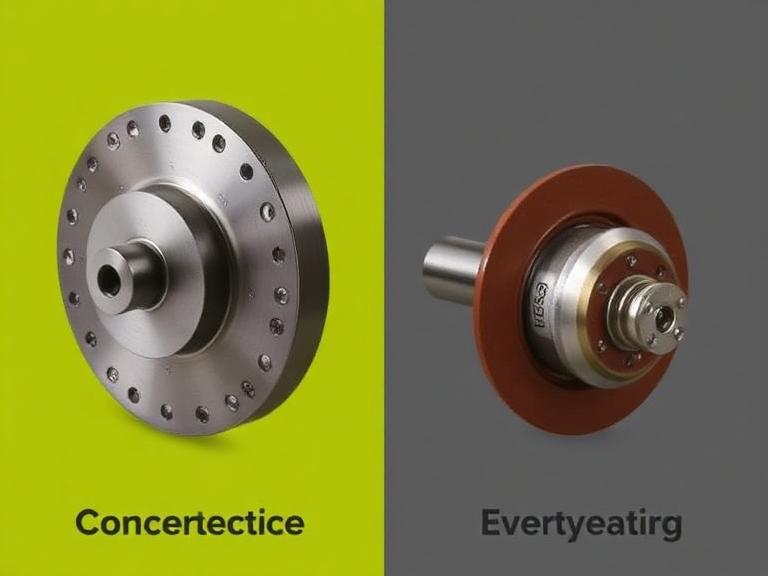
Understanding the precise difference between concentric and eccentric reducers is non-negotiable for commercial users handling chemical processing, petrochemical transport, and heavy-duty water treatment. A pipe reducer is not merely a piece of metal bridging a gap; it is a critical flow-control component. In this comprehensive engineering guide, we will analyze the technical distinctions between these two vital stainless steel pipe fittings, explain exactly when to use each, and provide actionable buying advice to ensure your next piping project operates flawlessly.
Quick Answer: What is the Difference Between Concentric and Eccentric Reducers?
The primary difference between concentric and eccentric reducers lies in their geometric shape and centerline alignment, which dictates their installation orientation.
- Concentric Reducers: Shaped like a symmetrical cone. Both the large and small ends share the exact same central axis. They are exclusively used in vertical piping systems where maintaining the central flow line is necessary and fluid velocity changes uniformly.
- Eccentric Reducers: Shaped asymmetrically, with one side completely flat and the other side sloped. The centerlines of the two ends are offset. They are used in horizontal piping systems—specifically on the suction side of centrifugal pumps—installed with the flat side facing up (Flat Top) to prevent dangerous air or gas pockets from forming and causing pump cavitation.
Table of Contents
- What They Are: Defining Pipe Reducers
- How They Work: Fluid Mechanics
- The 5 Core Differences
- Benefits of Each Reducer
- Limitations and Restrictions
- Who Should Use It & Who Does Not Need It
- Common Mistakes in Piping Systems
- Buying Considerations
- Comparison Table
- Pros and Cons Table
- Expert Recommendation
- Frequently Asked Questions
What They Are: Defining Pipe Reducers
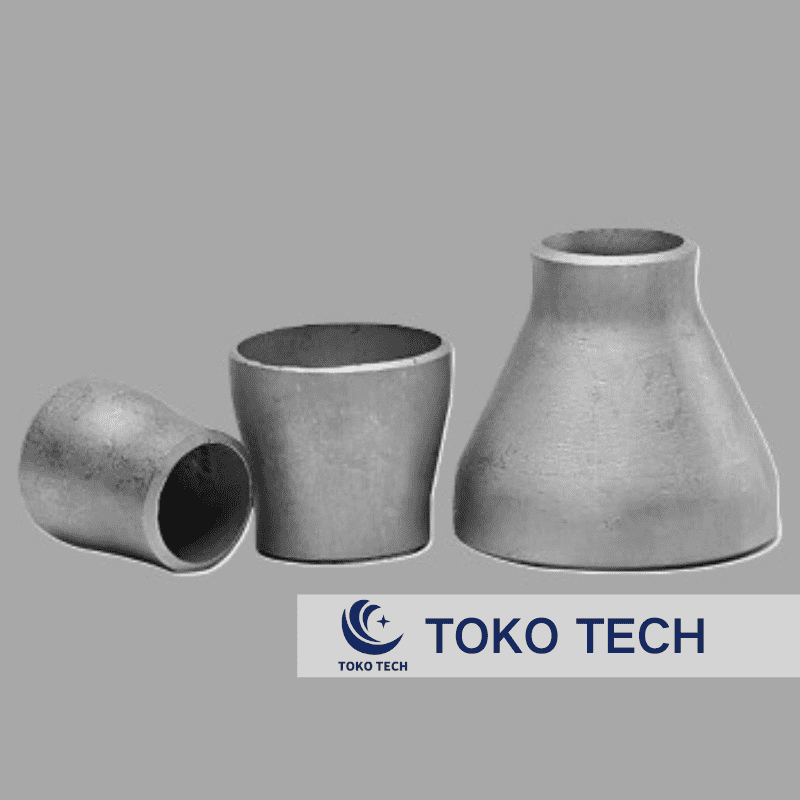
A pipe reducer is a specialized industrial pipe fitting utilized to connect two pipes of different outer diameters. By tapering the pipeline, the reducer allows the piping system to adapt to existing valves, adapt to different flow requirements, or connect to the inlet/outlet nozzles of heavy machinery like pumps and compressors.
At TOKO TECH, we manufacture and supply premium grade reducers tailored to the exact specifications required by heavy-duty applications. Below is an overview of the industry-standard specifications you must demand when sourcing these components.
Stainless Steel Reducers (Pipe Reducers)
- Type: Reducer (concentric, eccentric) seamless and welded.
- Standards: ASME B16.9, ASME B16.28, JIS B2311, JIS B2312, JIS B2313, DIN 2615, DIN 2616, DIN 2617.
- Production Range: 1/2″ ~ 100″ (DN15 ~ DN2500).
- Wall Thickness: Sch5 ~ Sch160 (1.5mm ~ 100mm).
- Austenitic Material: 304, 304L, 316, 316L, 317L, 310S, 321, etc.
- Duplex Stainless Steel: S31803(2205), 32205, S32760, S32750, etc.
- Production Process: Cold pushing, cold extrusion.
How They Work: Fluid Mechanics
In most professional situations, changing a pipe diameter is not just about physical connection; it is an application of Bernoulli’s principle. As fluid moves from a larger diameter pipe into a smaller diameter pipe through a reducer, the velocity of the fluid increases, and the static pressure decreases. Conversely, when expanding from small to large, velocity drops and pressure recovers. How the reducer handles this transition—whether the flow converges symmetrically or is directed asymmetrically—dictates the level of turbulence and friction loss introduced into the system.
The 5 Difference Between Concentric and Eccentric Reducers
Understanding the difference between concentric and eccentric reducers requires analyzing their geometry, installation rules, and how they interact with liquid and gas phases. Here are the five definitive differences.
1. Centerline Alignment vs. Offset Geometry
The most visually obvious difference is geometry. A concentric reducer is perfectly symmetrical. If you draw a line straight through the center of the large end, it passes perfectly through the center of the small end. An eccentric reducer is asymmetrical. The centerline of the small end is offset from the centerline of the large end. This results in one side of the eccentric reducer being completely flat, while the opposite side features an angled taper.
2. Vertical vs. Horizontal Installation
From our experience, this is the golden rule of piping: Concentric reducers belong on vertical pipes. Eccentric reducers belong on horizontal pipes. When fluids travel vertically, gravity acts uniformly across the cross-section of the pipe, making the symmetrical taper of a concentric reducer ideal. When fluids travel horizontally, utilizing a concentric reducer creates a physical trap at the top of the fitting where air or vapor can accumulate.
3. Cavitation and Air Trap Prevention
This is the most critical functional difference in industrial settings. When pumping liquids, especially in suction lines drawing fluid into a centrifugal pump, air pockets are catastrophic. If you use a concentric reducer on a horizontal suction line, the upper tapered curve creates a void where air bubbles accumulate. Eventually, these bubbles are sucked into the pump, causing cavitation—a phenomenon where bubbles violently collapse, physically destroying the pump impeller. An eccentric reducer, installed with the flat side facing up (Flat Top), entirely eliminates this void, allowing air bubbles to pass smoothly through the system without pooling.
4. Liquid Pooling and Drainage
In applications where you must maintain a consistent slope for drainage, or when transporting fluids carrying heavy solid particulates (slurries), eccentric reducers are used with the flat side facing down (Flat Bottom). This maintains the invert elevation of the pipe, allowing liquids and solids to drain completely without pooling at the transition point. Concentric reducers would create a physical lip at the bottom, causing solids to build up and eventually clog the line.
5. Space and Pipe Rack Clearance
When running parallel pipes along a structural pipe rack, maintaining uniform clearance beneath the pipes is vital for support installation. Using an eccentric reducer with the flat side down ensures that the bottom of the piping system remains perfectly level against the steel supports, even as the pipe diameter shrinks. Concentric reducers would cause the smaller pipe to “float” above the pipe support, requiring additional blocking or custom shims.
Benefits of Each Reducer
Benefits of Concentric Reducers: Because they are symmetrical, they are cheaper to manufacture and structurally simpler to analyze for stress. They offer uniform friction distribution, making them the superior choice for high-pressure vertical drops or vertical pump discharge lines where cavitation is not a risk.
Benefits of Eccentric Reducers: They are the ultimate safeguard for expensive rotating equipment. By keeping the top of a horizontal line perfectly flat, they protect million-dollar pumps from cavitation failure. Furthermore, they allow engineers to seamlessly manage pipe rack elevations without complex support modifications.
Limitations and Restrictions
Concentric reducers are strictly limited to vertical orientations or horizontal gas/steam lines where liquid pooling is not a concern. Using them on horizontal liquid suction lines is a severe engineering violation.
Eccentric reducers are heavily dependent on correct orientation. If a technician installs an eccentric reducer upside down (Flat Bottom instead of Flat Top on a pump suction line), they instantly create the exact air trap the fitting was designed to prevent. They also introduce slightly asymmetrical flow turbulence, which must be accounted for in highly sensitive laminar flow applications.
Who Should Use It & Who Does Not Need It
For commercial users and chemical engineers: If you are designing a refinery, a desalination plant, or utilizing nickel alloy tube and pipe systems for highly corrosive environments, you absolutely must use eccentric reducers on all horizontal pump suctions. The cost of replacing a cavitation-damaged pump vastly outweighs the marginal cost difference of the fitting.
Who does not need eccentric reducers: For beginners designing simple vertical gravity drains, residential plumbing drops, or high-pressure vertical gas vents, eccentric reducers are unnecessary. Standard concentric reducers will handle these vertical applications flawlessly and more economically.
Common Mistakes in Piping Systems
In our testing and field audits, the most devastating mistake is the improper installation of eccentric reducers on pump suction lines. As stated, the flat side must be UP. We frequently see field crews install them with the flat side down because “it looks better” or it aligns easier with the pipe support. This guarantees air accumulation and eventual pump failure.
Another common mistake is sourcing the wrong manufacturing method. Knowing the difference between erw and seamless pipe applies directly to fittings. For extreme high-pressure applications, you must specify seamless reducers. Welded (ERW) reducers are acceptable for lower pressure utilities, but pushing a welded reducer beyond its specific schedule rating is highly dangerous.
Buying Considerations
When sourcing reducers from seamless pipe manufacturers or top-tier stainless steel pipe manufacturers usa, you must evaluate the following specifications:
| Specification | What to Look For | Why It Matters |
|---|---|---|
| Manufacturing Standard | ASME B16.9 (Butt-Welding Fittings) | Ensures the dimensions, tolerances, and wall thicknesses are globally certified for safety and compatibility. |
| Material Grade | Austenitic (316L) or Duplex (2205) | 316L offers excellent standard corrosion resistance. Duplex offers superior strength for high-pressure or chloride-rich environments. |
| Wall Thickness (Schedule) | Must match the adjoining stainless steel seamless pipe (e.g., Sch 40, Sch 80). | Mismatched wall thicknesses create internal flow disruption and weak points at the weld seam. |
| Formation Process | Cold pushing or cold extrusion for seamless. | Cold forming maintains the structural grain of the steel, ensuring maximum burst strength under pressure. |
Comparison Table: Concentric vs Eccentric Reducers
| Feature | Concentric Reducer | Eccentric Reducer |
|---|---|---|
| Physical Shape | Symmetrical, cone-shaped | Asymmetrical, offset cone (one flat side) |
| Centerline Alignment | Maintains exact center axis | Offsets the center axis |
| Primary Orientation | Vertical Piping | Horizontal Piping |
| Pump Suction Lines | NEVER use on horizontal suction | ALWAYS use on horizontal suction (Flat Top) |
| Air Trap Potential | High (if used horizontally) | Zero (when installed correctly) |
| Fluid Type | Clean liquids, gases, steam (vertical) | Liquids, slurries, two-phase flows (horizontal) |
Pros and Cons Table
| Fitting Type | Pros (Benefits) | Cons (Limitations) |
|---|---|---|
| Concentric Reducer |
|
|
| Eccentric Reducer |
|
|
Expert Recommendation
We recommend approaching pipe reducers not as simple connectors, but as vital protective infrastructure. From our experience supplying heavy industry, the financial fallout of a cavitation-destroyed pump impeller dwarfs the cost of any pipe fitting. If you are piping horizontally into a pump, use an eccentric reducer with the flat side up. Period. If you are dropping flow vertically down a column, use a concentric reducer. When ordering your materials, insist on ASME B16.9 compliance and ensure your wall thickness schedules perfectly match your adjoining seamless pipes to guarantee weld integrity.
Frequently Asked Questions (FAQ)
Why do we use an eccentric reducer at the pump suction?
We use an eccentric reducer installed with the flat side facing up (Flat Top) on horizontal pump suction lines to prevent the accumulation of air or vapor pockets. If a concentric reducer were used, air would become trapped at the top of the taper, eventually entering the pump and causing cavitation, which physically destroys the internal components.
When should you use a concentric reducer instead of an eccentric reducer?
Concentric reducers should be used strictly in vertical piping systems, or in horizontal gas and steam systems where the accumulation of liquid or gas pockets is not a concern. They provide symmetrical flow transitions, which minimizes friction loss in vertical orientations.
Can I install an eccentric reducer with the flat side down?
Yes, but only in specific scenarios. You install an eccentric reducer with the flat side down (Flat Bottom) on horizontal lines when you need to ensure complete drainage of the pipe, or when transporting slurries to prevent solid particulates from pooling and clogging at the transition point. It is also used flat side down to maintain a level bottom alignment on pipe rack supports.
References & Authoritative Sources
- American Society of Mechanical Engineers (ASME) – Standards for B16.9 Factory-Made Wrought Buttwelding Fittings.
- American Petroleum Institute (API) – Guidelines for centrifugal pump piping, cavitation prevention, and suction line design (API 610).
- Hydraulic Institute (HI) – Engineering standards governing pump intake design and the proper application of eccentric reducers to mitigate Net Positive Suction Head (NPSH) issues.
 English
  Spanish
  Russian
  Turkish
  French
  Korean
  German
  Italian