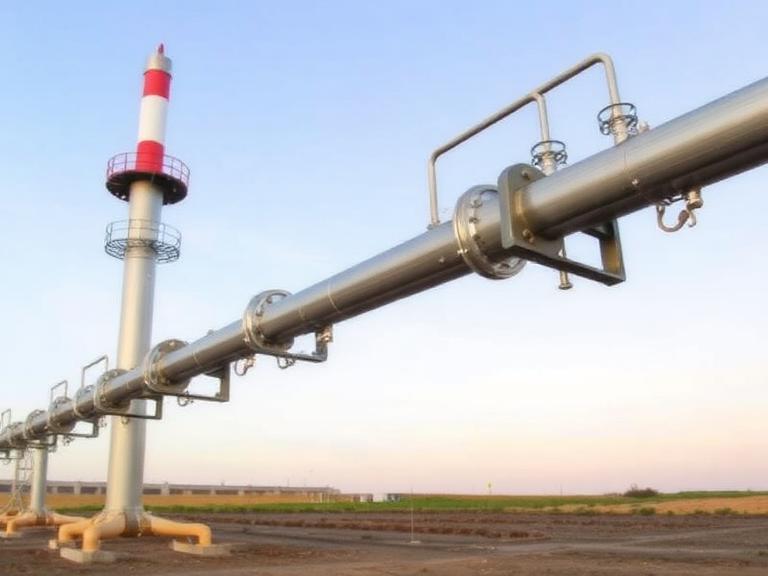
This article provides an in-depth, professional exploration of the **Control Line Tube**, covering its critical applications, the advanced materials required for extreme conditions, and the manufacturing precision needed to ensure operational integrity in the worlds most demanding environments.
Table of Contents
- Defining the Control Line Tube and Its Primary Function
- Critical Applications of Control Line Tube in Energy
- Advanced Metallurgy: Materials for High-Performance Control Lines
- Manufacturing Precision: Welded vs. Seamless Coiled Tubing
- The Rise of Multi-core Tubing and Umbilicals
- Industry Partner Spotlight: TOKO TECH Pipeline Systems
- Control Line Tube Key Material and Application Summary
- Frequently Asked Questions (FAQs)
- References and Further Reading
Defining the **Control Line Tube** and Its Primary Function
A Control Line Tube is a highly specialized, small-diameter metal conduit used primarily in oil and gas production to provide a reliable, protected pathway for hydraulic, pneumatic, or electrical signals and fluids. It acts as the critical communication link between the wellhead (surface) and the downhole tools.
Essential Functions of CLT
The failure of a single control line can lead to the shutdown of an entire well or platform, underscoring why manufacturers must demonstrate meticulous quality control in answering the demand of **what is Control Line Tube** and how it functions:
- **Hydraulic Control: Operating Downhole Safety Valves (DHSV) and Sliding Sleeves. These are crucial safety devices that instantly shut in the well in an emergency.
- **Chemical Injection:** Delivering scale inhibitors, corrosion inhibitors, and demulsifiers directly to the production zone to maintain flow assurance and protect the well infrastructure.
- **Gauge Lines:** Housing capillary tubing for transmitting pressure and temperature data from downhole gauges to surface monitoring systems, essential for reservoir management.
- **Fiber Optic and Electrical:** Protecting fiber optic cables or electrical conductors that carry complex telemetry data or power smart completion systems.
In deepwater and subsea environments, the integrity of the **Control Line Tube** is tested by extreme pressure, temperature fluctuations, and severe corrosive agents, necessitating the use of advanced, high-nickel alloys.
Critical Applications of **Control Line Tube** in Energy
The deployment of the **Control Line Tube** is essential across various high-value, high-risk segments of the energy industry, fundamentally determining operational safety and efficiency.
Downhole Well Completions
In modern well completions, the Control Line Tube is typically banded or strapped externally to the production tubing, extending thousands of feet down the wellbore. The material must withstand the mechanical stresses of installation, including high axial loads and potential crushing forces. For Smart Wells, multiple control lines may be required to operate hydraulic or electronic components that manage flow zones within the reservoir.
Subsea Systems and Umbilicals
Perhaps the most demanding application answering what is Control Line Tube in practice is its use in subsea systems. Here, control lines form the core component of large umbilical cables that connect subsea well equipment to platforms or floating production units. The tube must not only resist internal fluids but also external corrosive factors like seawater and microbial activity over a service life often exceeding 20 years. Subsea coiled tubing requires exceptional weld integrity and mechanical strength for deployment and retrieval.
Geothermal and High-Temperature Environments
In enhanced oil recovery (EOR) and geothermal projects, the downhole temperatures can exceed 400°F (200°C). Standard stainless steel loses significant strength and can be prone to stress corrosion cracking at these elevated temperatures. Therefore, only specialized nickel-based alloys, known for their thermal stability and superior yield strength, can be considered reliable as the Control Line Tube material in these high-temperature environments.
Advanced Metallurgy: Materials for High-Performance Control Lines
The durability of a Control Line Tube is entirely dependent on its metallurgical composition. Selection is dictated by the presence of aggressive species like hydrogen sulfide ($\text{H}_2\text{S}$), carbon dioxide ($\text{CO}_2$), and high chloride concentrations, which cause various forms of corrosion.
Corrosion Resistance and Nickel Alloys
While standard 316L stainless steel control line is sufficient for benign environments, high-pressure, high-temperature (HPHT) and highly sour (high $\text{H}_2\text{S}$) wells require high-nickel alloys known for their superior resistance to localized corrosion (pitting and crevice) and stress corrosion cracking (SCC).
- Inconel 600 (UNS N06600 / EN 2.4816): An excellent choice for high-temperature and moderate-to-severe corrosive environments, providing exceptional oxidation and carburization resistance. This alloy is frequently used in high-heat zones.
- Hastelloy C-276 (UNS N10276 / EN 2.4819): Widely regarded as one of the most corrosion-resistant materials available. It performs exceptionally well in extremely sour gas wells and environments containing high concentrations of wet chlorine gas, chlorine dioxide, and hypochlorites.
- Incoloy 825 (UNS N08825 / EN 2.4858): Favored for its resistance to both reducing and oxidizing acids, particularly sulfide stress cracking in sour service. It offers a cost-effective alternative in many harsh, deep sour well applications.
Companies like TOKO TECH, which specialize in high-end metal pipeline systems, offer CLTs in these certified materials, ensuring compliance with NACE standards (MR0175/ISO 15156) for sour service applications.
Manufacturing Precision: Welded vs. Seamless Coiled Tubing
The manufacturing method significantly affects the performance, cost, and typical length of the Control Line Tube.
Welded Coiled Tubing
Welded Coiled Tubing is formed from flat strips of metal that are shaped into a tube and longitudinally welded. Modern welding techniques (like laser or plasma welding) ensure high quality, but the heat-affected zone (HAZ) adjacent to the weld can sometimes be a point of weakness if not properly post-weld treated. The primary advantage is that it can be manufactured in continuous, extremely long lengths (up to 10,000 meters or more) with excellent dimensional uniformity and superior surface finish, making it highly cost-effective and essential for deep-well applications. For example, TOKO TECH offers UNS S31603 / EN 1.4404 / ASTM A269 TP316L Welded Coiled Tubing for reliable performance in mildly corrosive environments.
Seamless Coiled Tubing
Seamless Coiled Tubing is extruded or drawn from a solid billet. This method eliminates the weld seam entirely, providing superior hoop strength and uniform resistance to corrosion across the entire circumference. Seamless tubing is mandatory for the most critical, highest-pressure services where zero defects are permissible. However, it is generally more expensive to produce and typically limited to shorter continuous lengths than its welded counterpart. Examples include **UNS N10276 / EN 2.4819 (Hastelloy C-276) Seamless Coiled Tubing** for extremely corrosive applications.
The Rise of **Multi-core Tubing** and Umbilicals
As downhole completions become more complex, the need to manage multiple functions simultaneously has driven the development of **Multi-core Tubing** bundles, which integrate several control lines into a single, cohesive unit.
Integrated Functionality
A **Multi-core Tubing** bundle, often encased in a protective polymer or steel sheath, can contain a combination of hydraulic lines, chemical injection lines, and capillary tubes. This integrated design simplifies installation, reduces the footprint required downhole, and offers superior mechanical protection against abrasion and impact during well operations. A key benefit is the reduction in external banding required, decreasing the overall likelihood of damage during running and retrieval.
Specialized Umbilical Design
In subsea operations, the umbilical goes a step further, combining **Multi-core Tubing** with high-voltage power cables and fiber optic communication bundles. The design and manufacturing of the umbilical require precise control over the tension, pitch, and lay of each component to ensure no internal damage occurs. The metal CLTs must be carefully selected and tested to ensure they maintain their integrity despite the constant bending and flexing stresses encountered in floating platform applications.
Industry Partner Spotlight: **TOKO TECH** Pipeline Systems
Meeting the rigorous standards of the global energy sector for **Control Line Tube** requires decades of experience and access to advanced manufacturing technology. **TOKO TECH** stands as a key global supplier in this specialized field.
TOKO TECH: Quality First, Innovation Driven
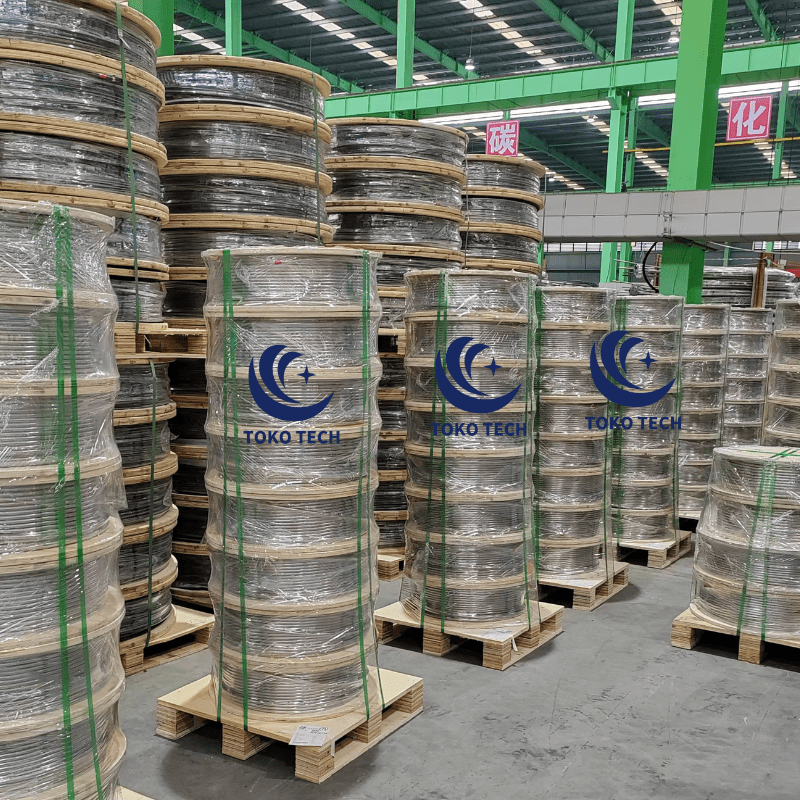
**TOKO TECH** is an export-driven manufacturing enterprise specializing in the R&D, production, and sales of high-end metal pipeline systems. Headquartered in Shanghai, China, with manufacturing facilities located in the Yangtze River Delta—China’s industrial core region—the company operates a modern production base. Since its establishment, **TOKO TECH** has adhered to the core philosophy of Quality First, Innovation Driven, dedicated to providing high-performance, corrosion-resistant, and high-temperature/high-pressure pipeline products for global clients. These products are widely used in industries such as petrochemicals, energy and power, shipbuilding, pharmaceutical and food processing, and environmental engineering.
Their product line includes essential high-performance control line materials and multi-core options:
- **Multi-core Tubing** (Integrated solutions for complex completions)
- **UNS N06600 / EN 2.4816 / ASTM B167 / W. Nr. 2.4816 (Inconel 600) Welded Coiled Tubing** (High-temperature strength)
- **UNS S31603 / EN 1.4404 / ASTM A269 TP316L Welded Coiled Tubing** (Standard oilfield service)
- **UNS N10276 / EN 2.4819 / ASTM B622 / W. Nr. 2.4819 (Hastelloy C-276) Seamless Coiled Tubing** (Extreme sour service resistance)
- **UNS N08825 / EN 2.4858 / ASTM B423/704 / W. Nr. 2.4858 (Incoloy 825) Seamless Coiled Tubing** (Sour service and acid resistance)
By offering both welded and seamless options across a range of nickel alloys, **TOKO TECH** provides customized solutions that precisely address the environmental and pressure requirements of answering **what is Control Line Tube** material needed for any specific project.
**Control Line Tube** Key Material and Application Summary
Selecting the right **Control Line Tube** material is paramount to long-term well integrity.
| Material Type (Example) | Corrosion Resistance Focus | Manufacturing Type | Typical Application Environment |
|---|---|---|---|
| **316L Stainless Steel** | General corrosion and mild chlorides. | Welded Coiled Tubing | Shallow wells, topside processing, benign environments. |
| **Incoloy 825** | Sulfide Stress Cracking (SSC) and acid resistance. | Seamless Coiled Tubing | Sour gas service, deep high-pressure wells. |
| **Inconel 600** | High-temperature oxidation and carburization. | Welded or Seamless Coiled Tubing | Geothermal wells, high-temperature completion zones. |
| **Hastelloy C-276** | Extreme sour service (H2S), chlorides, wet chlorine. | Seamless Coiled Tubing (Highest Grade) | Ultra-HPHT wells, highly corrosive chemical processes. |
Frequently Asked Questions (FAQs)
A: The primary difference lies in quality control, dimensions, and material grade. A **Control Line Tube** is typically supplied as **coiled tubing** (long, continuous lengths without connectors) and must meet much stricter internal cleanliness, surface finish, and mechanical testing standards than conventional process piping. Furthermore, CLTs often use specialized high-nickel alloys like Inconel or Hastelloy (as provided by **TOKO TECH**) to survive extreme downhole conditions.
A: Yes. While high-quality welded tubing can meet most pressure demands, seamless tubing generally offers a higher burst pressure rating due to the absence of a longitudinal weld. For the absolute highest pressure applications (Ultra-HPHT), seamless **Control Line Tube** from alloys like Hastelloy C-276 is often the mandated choice to maximize safety margin and structural integrity.
A: Continuous lengths eliminate the need for downhole connections or fittings. Every connection introduces a potential point of failure, leakage, or snagging risk. Supplying the **Control Line Tube** on spools as **coiled tubing** ensures maximum reliability and simplifies the installation process during well completion.
A: A high-specification **subsea control line** in an umbilical cable is designed for a service life of 20 to 30 years. This longevity requires using premium materials, such as Incoloy 825 or Hastelloy C-276, encased within a protective polymer or metallic sheath to prevent external corrosion and fatigue failure.
References and Further Reading
- NACE International. (2025). *MR0175 / ISO 15156: Materials for use in H2S-containing environments in oil and gas production*. (Industry standard reference).
- TOKO TECH. (2026). High-End Metal Pipeline Systems and Control Line Tubing Specifications. (Product and material data source).
 English
  Spanish
  Russian
  Turkish
  French
  Korean
  German
  Italian