In the complex world of mechanical engineering and industrial manufacturing, the integrity of your pipeline systems is paramount. Selecting the correct type of steel tubing can mean the difference between a high-performance, long-lasting system and a catastrophic failure under pressure. The debate of Seamless tubing vs DOM (Drawn Over Mandrel) is one of the most common technical discussions engineers and procurement managers face.

While both tubing types have established roles in the market, they possess distinct metallurgical properties, manufacturing processes, and cost structures. Seamless tubing is revered for its homogeneity and high-pressure capabilities, while DOM tubing is known for its superior dimensional tolerances and surface finish. This extensive guide will dissect the nuances of Seamless tubing vs DOM, helping you make an informed decision for your specific application in 2026.
İçindekiler
- 1. What is Seamless Tubing? Process and Characteristics
- 2. What is DOM Tubing? Understanding the “Welded” Reality
- 3. Manufacturing Processes Compared
- 4. Key Differences: Seamless Tubing vs DOM
- 5. Pressure Ratings and Structural Integrity
- 6. Dimensional Accuracy and Tolerances
- 7. Premium Seamless Solutions from TOKO TECH
- 8. Cost Analysis: Is Seamless Worth the Premium?
- 9. Common Applications and Use Cases
- 10. Summary Comparison Table
- 11. Frequently Asked Questions (FAQs)
- 12. Conclusion
1. What is Seamless Tubing? Process and Characteristics
Seamless tubing is exactly what the name implies: a tube without a seam. It is manufactured from a solid round steel “billet” that is heated and pushed or pulled over a form until the steel is shaped into a hollow tube. Because there is no welding involved, seamless tubing is considered to have a more uniform structure and strength distribution.
In the context of Seamless tubing vs DOM, seamless is often viewed as the heavy-duty option. The lack of a weld seam means there is no “weak point” (though modern welding is incredibly strong) and no variation in corrosion resistance along a longitudinal line. This makes seamless tubing the gold standard for critical applications involving high pressure, high temperature, or corrosive fluids.
Key Characteristics of Seamless Tubing:
- Homogeneity: The metallurgical structure is continuous throughout the circumference of the tube.
- High Pressure Resistance: Generally capable of withstanding higher operating pressures compared to welded tubes of the same dimension.
- Korozyon Direnci: Absence of a weld seam eliminates the risk of preferential corrosion at the weld zone.
- Availability: Available in heavy wall thicknesses that DOM cannot easily achieve.
2. What is DOM Tubing? Understanding the “Welded” Reality
A common misconception in the Seamless tubing vs DOM debate is that DOM is a type of seamless tube. This is incorrect. DOM stands for Drawn Over Mandrel. It is technically a welded tube that has undergone secondary processing.
The process starts with a strip of steel that is roll-formed into a tube and electric resistance welded (ERW). At this stage, it is basic welded tubing. To become DOM, the entire tube is then cold drawn through a die and over a mandrel. This process does two critical things: it improves the dimensional accuracy significantly, and it cold-works the weld seam to the point where it becomes virtually undetectable to the eye. The cold drawing process aligns the grain structure of the weld with the rest of the tube, giving it seamless-like properties.
Key Characteristics of DOM Tubing:
- Superior Concentricity: Because it starts as a flat strip of uniform thickness, the wall thickness of DOM is extremely consistent.
- Surface Finish: The cold drawing process creates a smooth, dense surface finish on both ID (Inner Diameter) and OD (Outer Diameter).
- Uygun Maliyetli: Generally less expensive to produce than seamless tubing for standard sizes.
- Weld Seam: Although cold-worked, a weld seam technically exists, which can be a limiting factor in ultra-high-pressure or corrosive environments.
3. Manufacturing Processes Compared
To truly understand Seamless tubing vs DOM, one must look at the factory floor. The route a piece of steel takes to become a tube dictates its final properties.
The Seamless Route
Seamless manufacturing is an intense hot-working process. It typically involves rotary piercing. A solid billet is heated to extreme temperatures and then pierced through the center while being rotated. This hot tube is then rolled and stretched to the desired size. Because it relies on the displacement of hot metal, precise wall thickness control can be challenging. Eccentricity (where the hole is slightly off-center) is a common tolerance issue with standard seamless tubing.
The DOM Route
DOM manufacturing is a cold-working process. It begins with high-quality steel strip coils. These coils are cold-rolled, ensuring exact thickness before the tube is even formed. After welding, the “drawn over mandrel” phase reduces the diameter and wall thickness simultaneously. This cold work hardens the steel, increasing its tensile strength significantly compared to hot-rolled seamless products, although stress-relief annealing is often required afterward.
4. Key Differences: Seamless Tubing vs DOM
When engineering a system, you are essentially trading off between “Uniform Structural Integrity” (Seamless) and “Precision and Surface Finish” (DOM).
1. Structural Homogeneity
Seamless: 100% homogeneous. No weld zone. Ideally suited for applications where failure is not an option, such as nuclear power or lethal gas transport.
DOM: Contains a weld zone. While the DOM process makes the weld chemically and mechanically similar to the parent metal, it is not identical. In highly corrosive environments, the weld area could be a site for intergranular attack.
2. Wall Thickness Consistency
DOM: The clear winner. Because it starts from a flat strip, the wall thickness is incredibly uniform.
Seamless: Prone to eccentricity. The ID might not be perfectly centered within the OD, leading to thin and thick spots along the wall.
3. Yüzey İşlemi
DOM: Has a mirror-like finish due to the burnishing effect of the mandrel. Excellent for hydraulic cylinders where seals move against the tube wall.
Seamless: Often has a rougher, mill-scale finish resulting from the hot forming process. It may require machining or honing if a smooth surface is needed.
5. Pressure Ratings and Structural Integrity
In the battle of Seamless tubing vs DOM, pressure rating is often the deciding factor. Seamless tubing generally boasts higher ASME (American Society of Mechanical Engineers) allowable working pressures because safety factors for welded tubing (DOM) typically require derating the material strength by 15% (a joint efficiency factor of 0.85).
However, the cold-working process of DOM increases the yield strength of the steel. In mechanical structural applications (like roll cages or automotive frames) where ASME pressure codes do not strictly apply, DOM can actually be stronger and stiffer than hot-rolled seamless tubing due to this work hardening.
6. Dimensional Accuracy and Tolerances
For applications requiring precise fit-up, telescoping parts, or high-speed machining, DOM is superior. The tolerances on DOM tubing are much tighter. Seamless tubing usually requires a larger allowance for machining to clean up the surface and correct concentricity issues.
If you are building a hydraulic cylinder, using DOM might save you an expensive honing operation. If you are building a high-pressure steam line, the dimensional variance of seamless is less important than its burst strength.
7. Premium Seamless Solutions from TOKO TEKNİK
When your project demands the absolute highest standards in corrosion resistance, temperature endurance, and pressure handling, generic options may not suffice. This is where specialized manufacturers like TOKO TECH excel.
Professional Manufacturer of Precision Coil Tubing
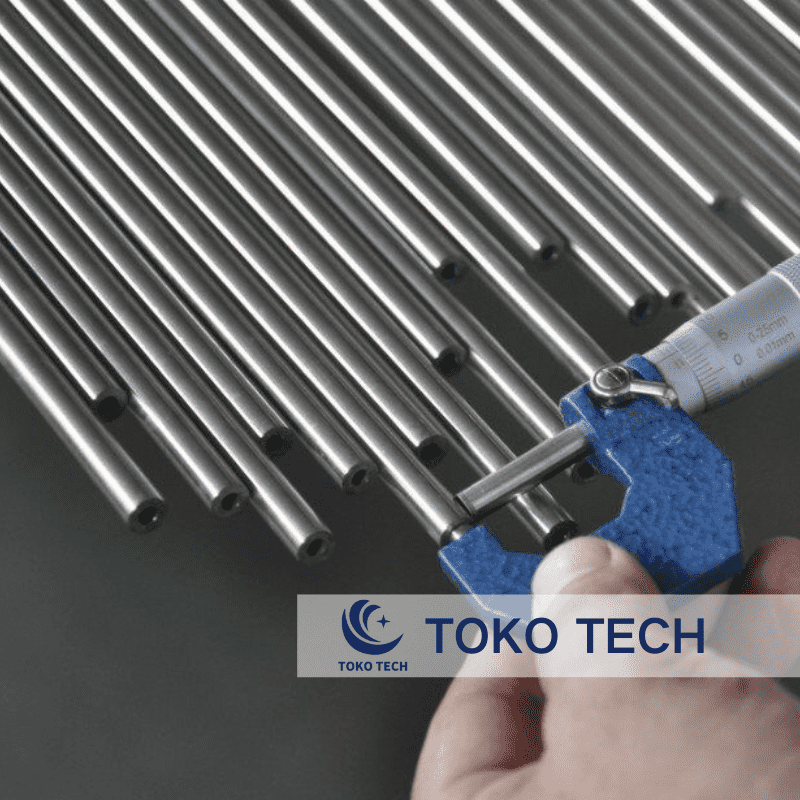
TOKO TEKNİK is an export-driven manufacturing enterprise specializing in the R&D, production, and sales of high-end metal pipeline systems. Headquartered in Shanghai, China, with manufacturing facilities located in the Yangtze River Delta—China’s industrial core region—the company operates a modern production base.
Since its establishment, TOKO TECH has adhered to the core philosophy of “Quality First, Innovation Driven”, dedicated to providing high-performance, corrosion-resistant, and high-temperature/high-pressure pipeline products for global clients. These products are widely used in industries such as petrochemicals, energy and power, shipbuilding, pharmaceutical and food processing, and environmental engineering.
Our Core Seamless Products Include:
- Paslanmaz çelik dikişsiz kangal boru – Ideal for long, continuous runs with minimal fittings.
- Paslanmaz çelik dikişsiz U-boru – Perfect for heat exchangers and boiler systems.
- Dikişsiz Düz boru/tüp – The standard for industrial fluid transport.
By choosing TOKO TECH, you are opting for seamless integrity that meets rigorous international standards, ensuring your project’s longevity and safety.
8. Cost Analysis: Is Seamless Worth the Premium?
Historically, seamless tubing has commanded a higher price point than DOM. The manufacturing process for seamless consumes more energy and is slower. DOM, leveraging efficient electric welding and rapid cold drawing, is generally more economical.
However, the “Total Cost of Ownership” must be considered.
Scenario A: You choose DOM for a chemical line to save money. The weld seam corrodes after 2 years, requiring a plant shutdown. The cost of downtime far exceeds the initial savings.
Scenario B: You choose Seamless for a simple structural bracket. You pay 30% more for the material and then spend extra money machining it to get the right dimensions. Here, Seamless was a waste of money.
9. Common Applications and Use Cases
Understanding where each type excels helps clarify the Seamless tubing vs DOM decision.
Where Seamless Tubing Wins:
- Petrokimya Tesisleri: Transporting aggressive chemicals where weld seams are vulnerability points.
- High-Pressure Steam: Boiler tubes and heat exchangers (like TOKO TECH’s U-tubes).
- Offshore Oil & Gas: Subsea umbilicals and downhole casing.
- Hydrogen Fuel Systems: Where molecular containment is critical.
Where DOM Tubing Wins:
- Automotive Components: Drive shafts, steering columns, and shock absorbers.
- Hydraulic Cylinders: The smooth ID surface is perfect for piston seals.
- Furniture & Gym Equipment: Where surface finish and aesthetic appearance matter.
- Motorcycle Frames: High strength-to-weight ratio and precise fitment.
10. Summary Comparison Table
| Özellik | Seamless Tubing | DOM Tubing |
|---|---|---|
| Üretim Süreci | Extrusion / Rotary Piercing (Hot Work) | ERW + Cold Drawn (Cold Work) |
| Weld Seam | None (Homogeneous) | Yes (but cold worked invisible) |
| Concentricity | Fair (Eccentricity possible) | Excellent (Uniform wall) |
| Yüzey İşlemi | Rougher (Mill scale) | Smooth / Polished |
| Basınç Derecesi | Highest (ASME rated) | High (Derated for weld) |
| Maliyet | Higher | Lower to Moderate |
| Birincil Kullanım | Critical Pressure / Corrosion | Precision Mechanical / Structural |
11. Frequently Asked Questions (FAQs)
12. Conclusion
The choice between Seamless tubing vs DOM is not about which is “better” in the abstract, but which is “correct” for the application. For mechanical precision, tight tolerances, and cost-effective structural strength, DOM is the undisputed leader. It powers the automotive and machinery industries efficiently.
 Turkish
  English
  Spanish
  Russian
  French
  Korean
  German
  Italian