In the complex and demanding world of upstream oil and gas, the integrity of downhole communication is paramount. The hydraulic control line for oilfield completions serves as the critical nervous system of a well, transmitting hydraulic power to actuate Surface Controlled Subsurface Safety Valves (SCSSV), chemical injection valves, and intelligent well completion devices. A failure in a control line can lead to catastrophic loss of well control, expensive workovers, or halted production.
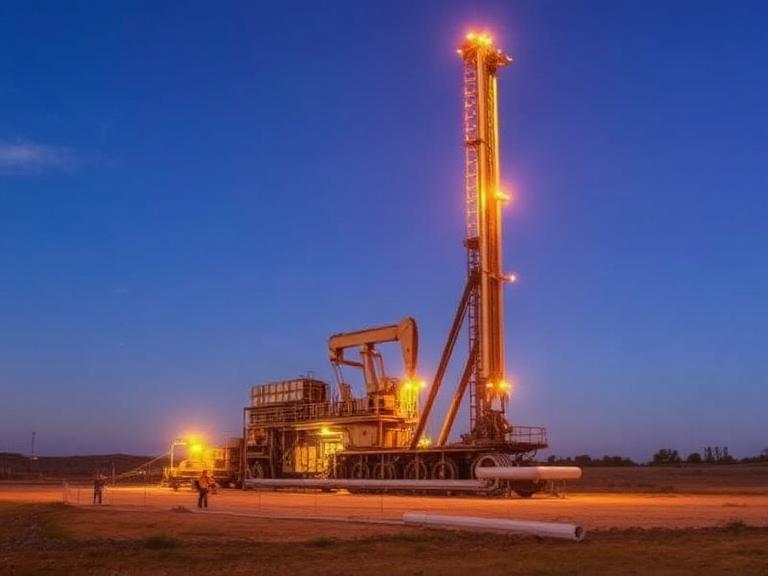
Selecting the correct material and configuration for a hydraulic control line for oilfield completions is not a “one size fits all” decision. It requires a deep understanding of the downhole environment, including temperature, pressure, and the corrosive nature of formation fluids. From standard stainless steel to exotic nickel alloys, the choices available today are engineered to withstand everything from sweet gas environments to ultra-high-pressure, high-temperature (HPHT) sour wells. This guide explores the five best materials dominating the market in 2026, helping engineers and procurement managers make informed decisions for their completion designs.
Featured Manufacturer: Shanghai Toko Technology Co., Ltd.
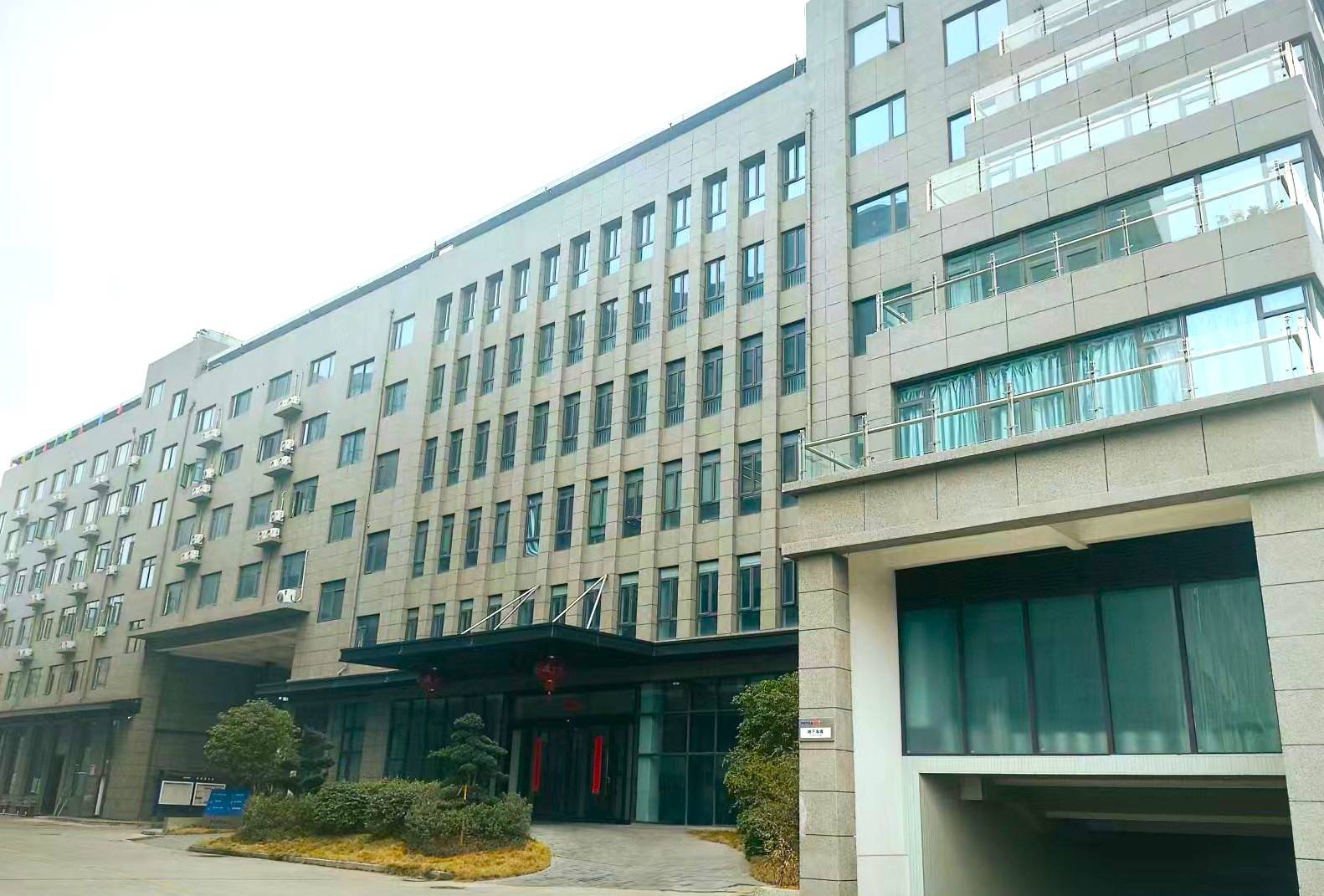
Shanghai Toko Technology Co., Ltd. is located in Shanghai, China, and has been worked in the field of industrial piping for 11 years. We are committed to manufacturing and exporting stainless steel seamless pipe, stainless steel welded pipes, stainless steel fittings and flanges, nickel alloy products, Titanium seamless and welded tubes, etc.
Our factories are all ISO&PED certificated, and the products can be produced in standard ASTM, JIS, DIN, EN, GOST, etc. Our products are widely used in the Oil and Gas, Petrochemical, Sugar Refining, Water Process, Desalination, Geothermal industry, etc. We exported to dozens of countries and regions such as USA, Canada, Japan, Germany, France, Korea, Turkey, etc.
Key Products for Completions:
1. Understanding Hydraulic Control Lines
Before diving into specific alloys, it is essential to understand what a hydraulic control line for oilfield completions actually does. These small-diameter tubes (typically 1/4″ or 3/8″ OD) run from the wellhead down to various tools in the completion string. They are usually strapped to the production tubing and can be encapsulated in plastic flat-packs for added protection against crushing and abrasion during installation.
The lines maintain hydraulic pressure to keep safety valves open (failsafe closed design). If the pressure is bled off at the surface, the valve snaps shut, securing the well. Because they are permanently installed and inaccessible after the completion is run, reliability is the single most important factor. The tubing must resist bursting from internal pressure, crushing from external annular pressure, and corrosion from the wellbore fluids.
Manufacturing processes typically fall into two categories: Seamless and Welded. Seamless tubing is extruded and drawn without a seam, offering uniform strength. Welded tubing (often preferred for 316L due to cost) is formed from a strip and welded, then drawn to size. Both methods, when executed to ASTM standards by reputable manufacturers like Shanghai Toko Technology, provide reliable service.
2. The 5 Best Hydraulic Control Line Materials
The “best” line depends entirely on the well environment. Below are the top 5 materials used globally, ranked by versatility and specific application strengths.
2.1 316L Stainless Steel (UNS S31603)
Best For: Standard service, cost-effectiveness, and general chemical injection.
316L Stainless Steel is the workhorse of the industry. It is an austenitic chromium-nickel stainless steel containing molybdenum, which increases corrosion resistance and mechanical strength. The “L” stands for “Low Carbon,” which is critical for welding operations as it minimizes carbide precipitation.
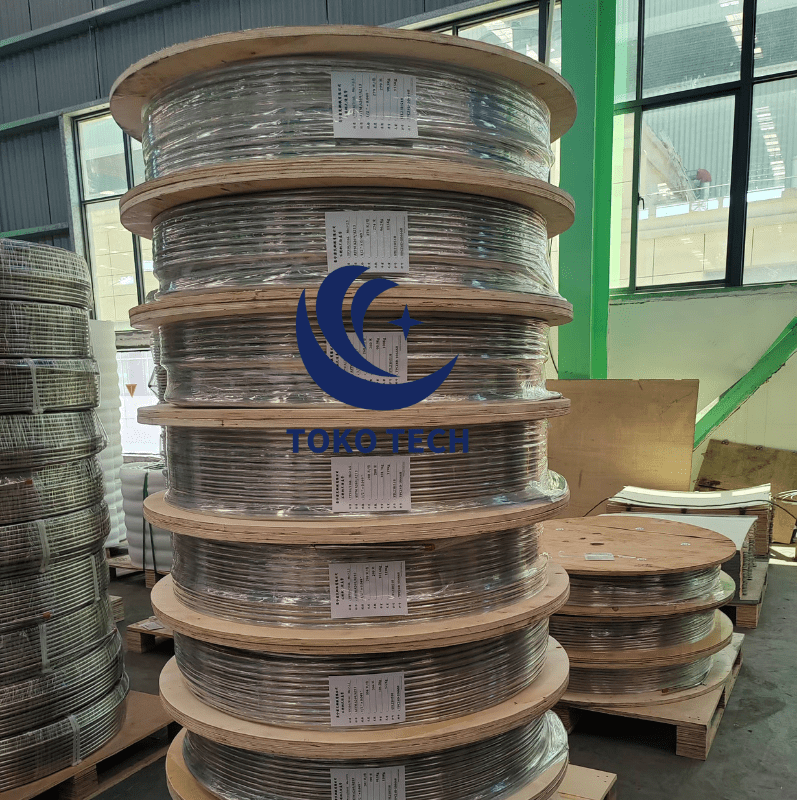
For many onshore and shallow offshore wells where H2S (hydrogen sulfide) and CO2 levels are low, 316L provides excellent performance at a fraction of the cost of nickel alloys. It is widely available in long continuous lengths, particularly as ASTM A269 TP316L Welded Coiled Tubing offered by Shanghai Toko Technology. This welded option is cost-efficient and has a proven track record in tens of thousands of wells globally.
Key Properties:
- Excellent general corrosion resistance.
- Good mechanical properties for hydraulic pressure containment.
- Cost-effective for benign to mildly corrosive environments.
- Susceptible to chloride stress corrosion cracking (SCC) at higher temperatures (above 60°C).
2.2 Alloy 825 (Incoloy 825 / UNS N08825)
Best For: Sour service (H2S), moderate temperatures, and acidizing environments.
When well conditions become aggressive, standard stainless steel fails. Alloy 825 is a nickel-iron-chromium alloy with additions of molybdenum, copper, and titanium. This composition is specifically designed to provide exceptional resistance to many corrosive environments. It bridges the gap between stainless steel and high-nickel alloys.
In the context of a hydraulic control line for oilfield completions, Alloy 825 is the industry standard for offshore wells where reliability is non-negotiable. Its high nickel content makes it virtually immune to chloride stress corrosion cracking, a common killer of 316L lines in marine environments. Furthermore, the copper addition makes it resistant to sulfuric and phosphoric acids, which is beneficial during well stimulation (acidizing) operations.
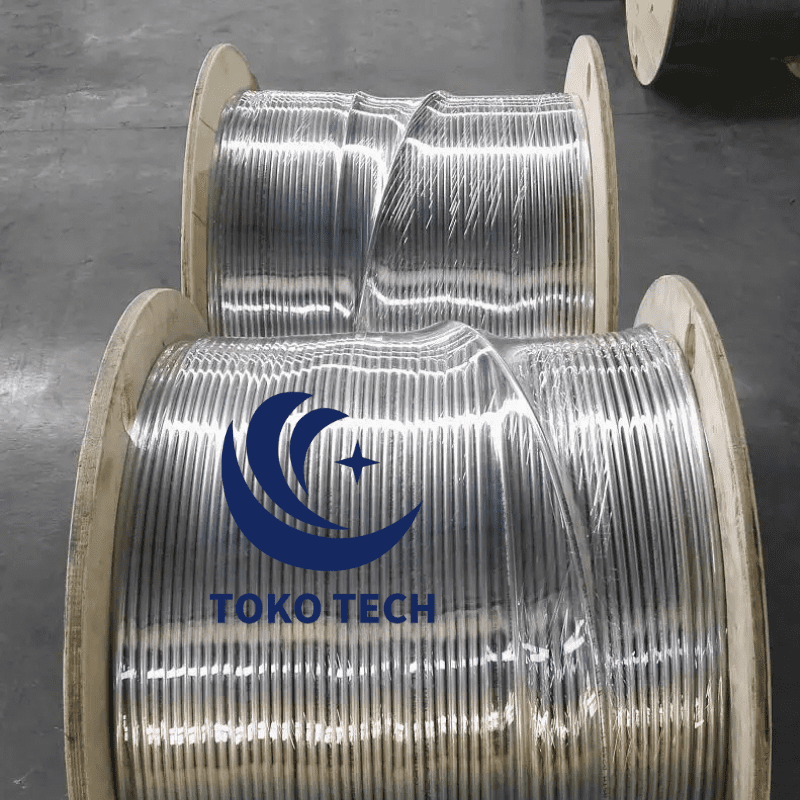
Shanghai Toko Technology offers UNS N08825 / ASTM B423 Seamless Coiled Tubing, ensuring high integrity without the potential weak points of a weld seam in critical sour environments.
Key Properties:
- Resistant to Chloride Stress Corrosion Cracking.
- Excellent resistance to reducing acids (sulfuric/phosphoric).
- Suitable for sour gas wells (H2S compliant per NACE MR0175).
- Operating temperature range significantly higher than 316L.
2.3 Alloy 800 (Incoloy 800 / UNS N08800)
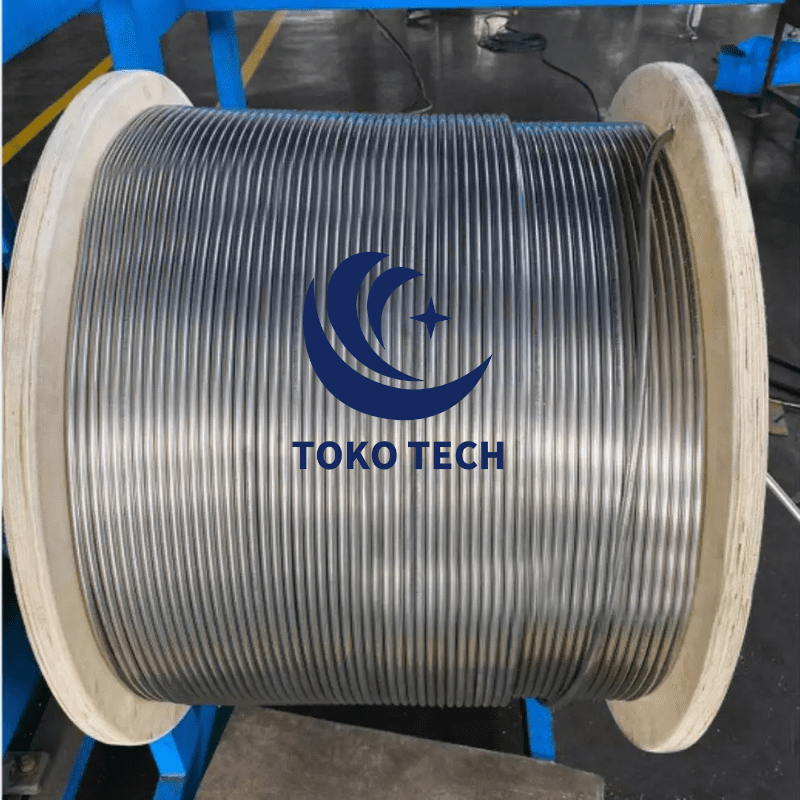
Best For: High-temperature stability and resistance to oxidation.
Alloy 800 is a nickel-iron-chromium alloy known for its high strength and excellent resistance to oxidation and carburization at high temperatures. While traditionally associated with heat exchangers and furnace components, it has found a valuable niche in downhole completions where thermal stability is critical.
In Steam Assisted Gravity Drainage (SAGD) wells or geothermal applications, the downhole temperatures can exceed the stable limits of standard alloys. Alloy 800 maintains its austenitic structure and mechanical strength over extended periods of high heat exposure. It resists embrittlement and maintains ductility, ensuring the control line does not fracture under thermal expansion and contraction cycles.
Shanghai Toko Technology provides UNS N08800 / ASTM B407 Seamless Coiled Tubing, catering to these specialized high-thermal applications.
Key Properties:
- Maintains high tensile strength at elevated temperatures.
- Excellent resistance to oxidation.
- Resistant to chloride stress-corrosion cracking.
- Ideal for thermal recovery wells and geothermal applications.
2.4 Duplex 2205 (UNS S32205)
Best For: High pressure and high tensile loads.
Duplex stainless steels have a mixed microstructure of austenite and ferrite (roughly 50/50). This structure gives Duplex 2205 roughly twice the yield strength of austenitic stainless steels like 316L. This is a massive advantage for deepwater completions where the weight of the control line hanging in the annulus can be substantial, or where internal hydraulic pressures must be very high to operate deep-set valves.
In addition to strength, Duplex 2205 offers better resistance to pitting and crevice corrosion than 316L. It is a popular choice for CO2 injection wells or fields with high carbon dioxide content, as it resists CO2 corrosion effectively. However, it is generally limited to lower temperatures compared to high-nickel alloys.
Key Properties:
- Ultra-high yield strength (allows for thinner walls or higher pressure ratings).
- Superior resistance to pitting and crevice corrosion compared to 316L.
- Cost-effective alternative to high-nickel alloys in CO2 environments.
2.5 Alloy 625 (Inconel 625 / UNS N06625)
Best For: Extreme HPHT environments and extremely sour wells.
When the well conditions are classified as “severe,” Alloy 625 is the ultimate solution. It is a nickel-chromium-molybdenum alloy with an addition of niobium. This matrix provides immense strength without the need for heat treatment and outstanding corrosion resistance in the most aggressive environments.
Alloy 625 is virtually immune to chloride ion stress corrosion cracking and pitting. It is often used as a hydraulic control line for oilfield completions in ultra-deepwater projects or reservoirs with very high concentrations of H2S and elemental sulfur. While it is the most expensive option on this list, it provides the highest level of insurance against failure in wells where intervention costs could run into the tens of millions of dollars.
Key Properties:
- Highest level of corrosion resistance among standard control line alloys.
- High strength and toughness from cryogenic to 1800°F (980°C).
- Immune to chloride stress cracking.
- Premium choice for critical safety valve operations.
3. Critical Selection Factors for Oilfield Completions
Choosing between these five materials involves balancing risk, performance, and cost. Here are the main factors engineers must calculate:
3.1 Partial Pressure of H2S and CO2
The NACE MR0175 standard dictates material limits based on the partial pressure of corrosive gases. 316L is suitable for low pressures, while Alloy 825 is required as H2S increases. For extreme partial pressures, engineers must graduate to Alloy 625.
3.2 Bottom Hole Temperature (BHT)
Temperature affects both strength and corrosion rates. Chlorides become much more aggressive against stainless steels as temperature rises. Alloy 800 and Alloy 625 are preferred for high-temperature wells where creep resistance and thermal stability are required.
3.3 Mechanical Strength
Deep wells require lines with high tensile strength to support their own weight during installation. Duplex 2205 is excellent here. Additionally, the line must withstand “crush” forces if it is pressed against the casing wall. Encapsulation (plastic coating) helps distribute these loads, but the base metal must be robust.
3.4 Seamless vs. Welded
Seamless tubing (like Toko’s Alloy 825 and 800) typically offers higher pressure ratings and homogeneity, making it preferred for critical high-pressure applications. Welded tubing (like Toko’s 316L) is more economical and suitable for standard applications where the weld seam is inspected and redrawn to ensure integrity.
4. Summary Comparison Table
| Material | UNS Number | Corrosion Resistance | Strength | Primary Application |
|---|---|---|---|---|
| 316L Stainless | S31603 | Good (General) | Moderate | Standard onshore/shallow wells, chemical injection. |
| Alloy 825 | N08825 | Excellent (Sour) | High | Offshore, Sour Gas (H2S), Acidizing. |
| Alloy 800 | N08800 | Excellent (Oxidation) | Moderate/High | High Temp, Thermal Recovery, Geothermal. |
| Duplex 2205 | S32205 | Very Good (Pitting) | Very High | High pressure, Deep wells, CO2 environments. |
| Alloy 625 | N06625 | Superior | Very High | Extreme HPHT, Severe Sour Gas. |
5. Frequently Asked Questions (FAQs)
What is the difference between encapsulated and bare control lines?
Bare control lines are just the metal tubing. Encapsulated lines have a square or rectangular thermoplastic coating extruded over the tube. This encapsulation protects the metal from abrasion against the casing and allows for easier clamping (flat-packs) to the production tubing. Encapsulation is highly recommended for deviated or horizontal wells.
Can 316L be used in sour gas wells?
It depends on the severity. 316L has limited resistance to H2S cracking. Per NACE standards, it can be used only if the partial pressure of H2S is very low and the temperature is moderate. For any significant sour gas presence, Alloy 825 is the safer minimum standard.
Why is wall thickness important for hydraulic control lines?
Wall thickness determines two things: the burst pressure rating (how much hydraulic pressure it can hold to open the valve) and the collapse rating (how much external well pressure it can withstand). Common wall thicknesses are 0.035″, 0.049″, and 0.065″. Thicker walls are heavier and stiffer but safer in deep, high-pressure wells.
What certifications should a control line manufacturer have?
Reputable manufacturers like Shanghai Toko Technology should hold ISO 9001 certifications for quality management and PED (Pressure Equipment Directive) certifications if exporting to Europe. The tubing itself should meet specific ASTM standards (e.g., ASTM A269, B407, B423).
6. References
- NACE MR0175/ISO 15156 – Petroleum and natural gas industries — Materials for use in H2S-containing environments in oil and gas production.
- ASTM A269 – Standard Specification for Seamless and Welded Austenitic Stainless Steel Tubing for General Service.
 English
  Spanish
  Russian
  Turkish
  French
  Korean
  German
  Italian