In the highly demanding sectors of global heavy industry, the structural integrity of pipeline systems is not merely a matter of operational efficiency; it is a critical safety mandate. Plant managers, petroleum engineers, and procurement specialists frequently approach our technical teams with a fundamental, yet complex query: Is welded or бесшовная труба stronger? The answer requires a rigorous metallurgical analysis of manufacturing processes, material homogeneity, and application-specific stress factors. At TOKO TECH, we do not rely on theoretical assumptions. We rely on decades of empirical data and physical testing to provide our clients with absolute certainty.

From our experience engineering fluid transport solutions for extreme environments, the inquiry regarding Is welded or seamless pipe stronger must be addressed by examining the continuous physical structure of the metal itself. A pipe’s ability to withstand internal pressure, external mechanical stress, and corrosive degradation is directly tied to how it was formed in the mill. While modern metallurgical advancements have significantly narrowed the performance gap, fundamental architectural differences remain.
In this authoritative industry analysis, we will deconstruct the mechanical properties of both manufacturing methods. We will explore the precise engineering dynamics that dictate pressure ratings, longitudinal strength, and overall reliability. By the end of this comprehensive guide, you will have a definitive, technically sound answer to Is welded or seamless pipe stronger, enabling you to specify the optimal materials for your next high-stakes project.
Оглавление
- 1. Summary Table: Seamless vs. Welded Pipe Performance
- 2. Addressing the Core Question: Is welded or seamless pipe stronger?
- 3. The Metallurgical Advantage of Seamless Construction
- 4. The Evolution and Integrity of Welded Pipes
- 5. TOKO TECH: Pioneering High-End Metal Pipeline Systems
- 6. Industry-Specific Recommendations
- 7. Frequently Asked Questions (FAQs)
- 8. Industry References
1. Summary Table: Seamless vs. Welded Pipe Performance
To provide immediate clarity on the debate of Is welded or seamless pipe stronger, we have compiled a summary table highlighting the distinct mechanical characteristics and optimal use cases for both pipeline categories. This data reflects standard industry testing protocols and our proprietary manufacturing metrics.
| Performance Metric | Бесшовные трубы | Сварная труба |
|---|---|---|
| Structural Homogeneity | 100% Uniform (No longitudinal seam) | Non-uniform at the weld zone |
| Internal Pressure Rating | Exceptionally High (Approx. 20% higher capacity) | Moderate to High (Limited by weld seam integrity) |
| Устойчивость к коррозии | Superior (No weld seam to invite localized corrosion) | Good (Post-weld heat treatment required to prevent galvanic corrosion) |
| Dimensional Tolerance (Wall Thickness) | Variances can occur during the extrusion process | Highly precise due to rolled steel plate origins |
| Manufacturing Availability (Size) | Typically limited to 24 inches in outer diameter | Virtually unlimited outer diameter sizes |
| Recommended Application | High-temperature, high-pressure, critical fluid transport | Low-to-medium pressure, structural applications, large diameter transport |
2. Addressing the Core Question: Is welded or seamless pipe stronger?
When clients ask us, Is welded or seamless pipe stronger, we must first define what “strength” means in the context of industrial piping. Strength encompasses yield strength, ultimate tensile strength, and burst pressure capacity. From a purely structural and metallurgical standpoint, seamless pipe is inherently stronger than welded pipe. This conclusion is rooted in the physics of material continuity.
A seamless pipe is manufactured by drawing a solid billet of steel over a piercing rod to create a hollow shell. Because the entire pipe is formed from a single, continuous piece of metal, there is no longitudinal seam. The absence of a seam means there is no localized area of metallurgical weakness. When internal pressure acts upon the walls of a pipe, that pressure searches for the path of least resistance. In a welded pipe, the weld seam—despite advanced heat treatments—remains a microscopic area of altered grain structure. Therefore, when evaluating burst pressure thresholds and asking Is welded or seamless pipe stronger, the seamless configuration consistently yields a higher safety factor, typically offering up to 20% greater working pressure capacity for the exact same wall thickness and material grade.
3. The Metallurgical Advantage of Seamless Construction
The strength of a pipeline is not just about resisting pressure; it is about resisting environmental degradation. In industries processing highly volatile or caustic fluids, a pipeline must offer uniform resistance to chemical attacks. We recommend our Бесшовная труба/труба из никелевого сплава and our standard Бесшовная труба/трубопровод configurations for these exact scenarios.
Because there is no welding involved, seamless pipes do not possess a Heat Affected Zone (HAZ). In welded pipes, the intense heat required to fuse the steel plates alters the microstructure of the metal adjacent to the weld. This HAZ can become anodic relative to the rest of the pipe, leading to localized galvanic corrosion. By utilizing seamless construction, the metallurgical structure remains completely uniform from end to end. When plant operators dealing with aggressive media ask Is welded or seamless pipe stronger against corrosion fatigue, the uniform grain structure of the seamless variant makes it the undisputed superior choice.
4. The Evolution and Integrity of Welded Pipes
While we firmly establish the superiority of seamless pipes in extreme pressure scenarios, we must also acknowledge the massive advancements in welding technology. It is a misconception that welded pipes are inherently weak. Modern High-Frequency Electric Resistance Welding (ERW) and Longitudinal Submerged Arc Welding (LSAW) produce seams of extraordinary quality.
Our Сварная труба/трубопровод products undergo rigorous post-weld heat treatment (PWHT) to relieve residual stresses and normalize the grain structure across the weld zone. Furthermore, welded pipes offer a distinct advantage in dimensional accuracy. Because they are formed from precisely rolled steel plates or coils, the concentricity and wall thickness of a welded pipe are remarkably consistent. In applications where absolute wall thickness uniformity is required, and pressures are within standard operational limits, welded pipes provide exceptional performance. However, when the debate circles back to absolute ultimate burst pressure and the question of Is welded or seamless pipe stronger, the continuous architecture of the seamless pipe retains the definitive edge.
5. TOKO TECH: Pioneering High-End Metal Pipeline Systems
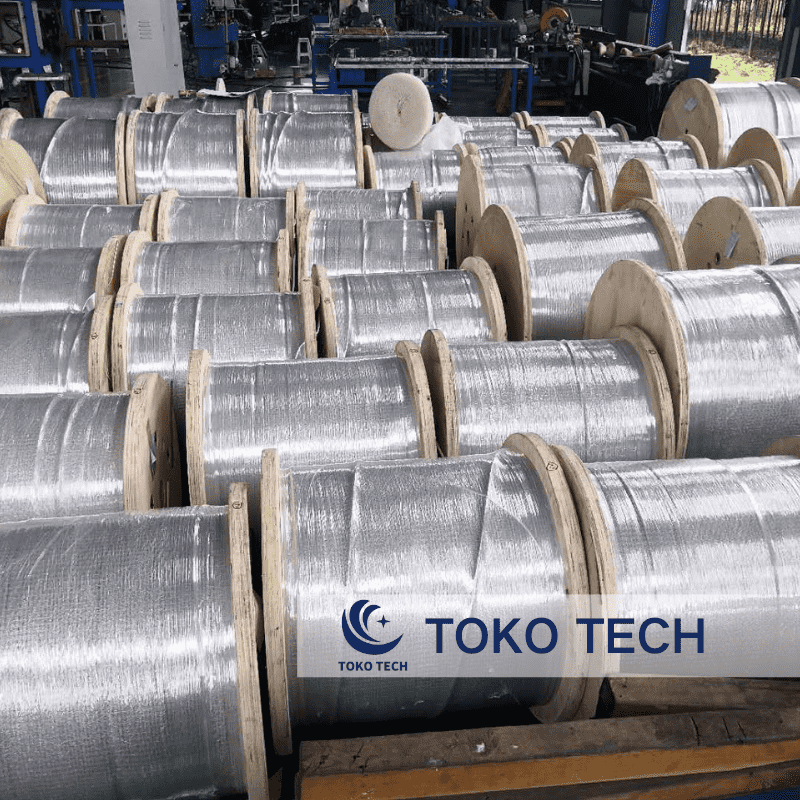
Answering complex engineering questions like Is welded or seamless pipe stronger requires a foundation of industrial expertise. TOKO TECH is an export-driven manufacturing enterprise specializing in the R&D, production, and sales of high-end metal pipeline systems. Headquartered in Shanghai, China, with manufacturing facilities located in the Yangtze River Delta—China’s industrial core region—the company operates a modern production base.
Since its establishment, TOKO TECH has adhered to the core philosophy of “Quality First, Innovation Driven”, dedicated to providing high-performance, corrosion-resistant, and high-temperature/high-pressure pipeline products for global clients. We do not simply sell steel; we engineer solutions. Our extensive catalog ensures that regardless of whether your project demands the continuous strength of a seamless extrusion or the large-diameter efficiency of a welded tube, we supply products that exceed international safety standards.
6. Industry-Specific Recommendations
The theoretical answer to Is welded or seamless pipe stronger must be translated into practical application. These products are widely used in industries such as petrochemicals, energy and power, shipbuilding, pharmaceutical and food processing, and environmental engineering. Here is how we recommend deploying our specific product lines:
Petrochemicals and Offshore Drilling
In offshore environments, the combination of high internal pressures and corrosive seawater demands the absolute highest strength-to-weight ratios. We highly recommend our Пруток/стержень из никелевого сплава for structural components and our seamless offerings for the primary fluid transport lines. The lack of a weld seam prevents the catastrophic failure mechanisms associated with localized corrosion.
Энергетика и производство электроэнергии
Modern power plants require continuous, uninterrupted lengths of tubing for heat exchangers and control systems. For these specialized applications, our Колтюбинг/труба контрольной линии provides the perfect solution, offering the continuous strength of seamless manufacturing in incredibly long, spoolable lengths, eliminating the need for vulnerable mechanical joints.
Фармацевтика и пищевая промышленность
Hygiene and cleanability are paramount in these sectors. While pressure may not be as extreme, the internal surface must be free of crevices where bacteria can harbor. We supply precision-engineered Фитинг для труб из нержавеющей стали and polished tubular products that ensure a sterile, easily cleanable fluid path, utilizing materials that strictly adhere to sanitary standards.
7. Frequently Asked Questions (FAQs)
Why is the question of Is welded or seamless pipe stronger so common in pipeline engineering?
Engineers frequently ask Is welded or seamless pipe stronger because calculating the burst pressure threshold is vital for safety. Seamless pipes provide a continuous, homogeneous structure that naturally distributes stress more evenly than a pipe featuring a longitudinal weld seam, making it the default choice for high-pressure, high-risk environments.
“`
Can welded pipes be used in high-pressure applications?
Yes, they can, provided they are manufactured utilizing advanced techniques like Double Submerged Arc Welding (DSAW) and undergo rigorous non-destructive testing (NDT) such as X-ray inspection. However, for the absolute highest pressure ratings, we recommend seamless variants.
Does the choice between welded and seamless affect the pipeline’s corrosion resistance?
Absolutely. The heat-affected zone (HAZ) adjacent to a weld can have a different metallurgical structure than the base metal, potentially inviting localized galvanic corrosion. Seamless pipes eliminate this risk entirely, offering uniform corrosion resistance across the entire pipe body.
How does TOKO TECH guarantee the strength of its pipeline systems?
At TOKO TECH, adhering to our “Quality First, Innovation Driven” philosophy, every batch of our pipeline products undergoes stringent hydrostatic testing, ultrasonic inspection, and metallurgical analysis at our Yangtze River Delta facilities to ensure they exceed the specified yield and tensile strength requirements.
“`
8. Industry References
1. American Society of Mechanical Engineers (ASME). “ASME B31.3: Process Piping Design and Allowable Stress Variables for Seamless and Welded Configurations.” 2025 Edition.
2. American Society for Testing and Materials (ASTM). “ASTM A312 / A312M: Standard Specification for Seamless, Welded, and Heavily Cold Worked Austenitic Stainless Steel Pipes.”
 Russian
  English
  Spanish
  Turkish
  French
  Korean
  German
  Italian