Introduction to Industrial Piping Materials
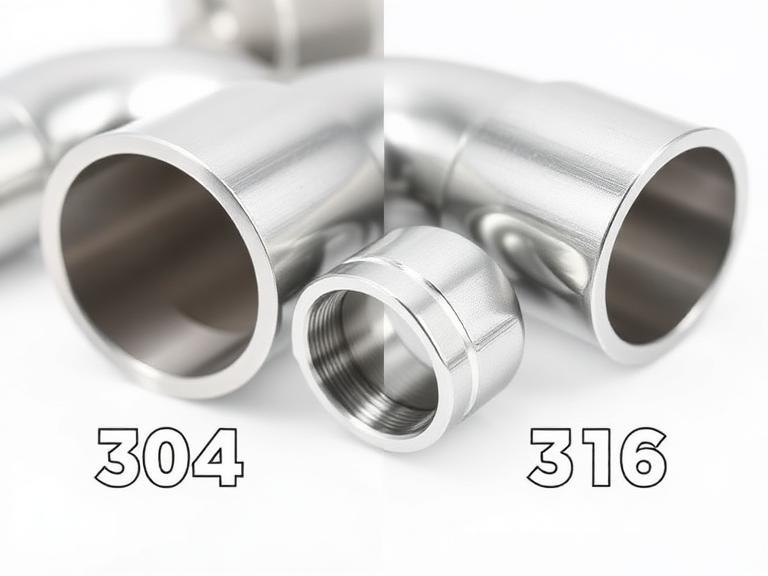
In the complex and demanding world of industrial piping, selecting the correct material is not merely a matter of preference; it is a critical engineering decision that impacts safety, operational longevity, and overall facility profitability. When designing piping systems for harsh environments, engineers consistently turn to austenitic stainless steels. However, a recurring dilemma faced by procurement teams and system designers alike involves understanding the exact difference between 304 and 316 stainless steel fittings. At a casual glance, these two grades appear identical, sharing the same polished finish and robust structural integrity. Yet, their performance under extreme chemical and environmental stress varies significantly.
목차
- Introduction to Industrial Piping Materials
- Chemical Composition: The Core Difference Between 304 and 316 Stainless Steel Fittings
- Corrosion Resistance and Environmental Tolerance
- Industrial Applications: Where to Use Which Grade
- Cost vs. Benefit Analysis
- TOKO TECH: Your Partner in Precision Engineering
- Summary Table: Direct Comparison
- 자주 묻는 질문(FAQ)
- Industry References and Standards
중국 상하이에 위치해 있습니다, TOKO TECH has worked in the field of industrial piping for 11 years. We are committed to manufacturing and exporting top-tier stainless steel seamless pipe, stainless steel welded pipes, stainless steel fittings, flanges, and nickel alloy products. From our experience supplying projects across the USA, Canada, Japan, Germany, France, Korea, and Turkey, we recognize that failing to grasp the difference between 304 and 316 stainless steel fittings can lead to catastrophic system failures or, conversely, unnecessary capital expenditure. This comprehensive guide will dissect the metallurgical, functional, and economic disparities between these two paramount steel grades.
Chemical Composition: The Core Difference Between 304 and 316 Stainless Steel Fittings
To truly comprehend the difference between 304 and 316 stainless steel fittings, one must examine their elemental makeup at the microscopic level. Both 304 and 316 belong to the 300 series of austenitic stainless steels, characterized by their high chromium and nickel content, which provides their fundamental resistance to oxidation and rust.
Grade 304, often referred to as 18/8 stainless steel, contains approximately 18 percent chromium and 8 percent nickel. This formulation creates a highly durable, versatile, and easily formable alloy. It is the most widely used stainless steel globally, serving as the standard baseline for commercial and industrial applications that do not involve extreme exposure to chlorides or marine environments.
Grade 316, on the other hand, shares a similar base but includes a crucial elemental addition: molybdenum. The addition of 2 to 3 percent molybdenum is the defining difference between 304 and 316 stainless steel fittings. Furthermore, 316 typically contains a slightly higher nickel content (ranging from 10 to 14 percent). This specific amalgamation of chromium, higher nickel, and molybdenum fundamentally alters the passive oxide layer on the surface of the steel, exponentially increasing its resistance to localized corrosive attacks.
Corrosion Resistance and Environmental Tolerance
The practical implication of adding molybdenum dictates the primary difference between 304 and 316 stainless steel fittings in the field: corrosion resistance. While 304 stainless steel offers excellent resistance to standard atmospheric corrosion, fresh water, and mild oxidizing chemicals, it possesses a distinct vulnerability to chloride environments. When exposed to saline conditions, de-icing salts, or coastal sea spray, 304 stainless steel is highly susceptible to pitting and crevice corrosion. Pitting is a localized form of corrosion that creates microscopic holes in the metal, which can rapidly penetrate the wall thickness of a fitting and cause a pressure leak.
We recommend utilizing Grade 316 when environmental factors demand maximum durability against chlorides. The molybdenum in 316 acts as a stabilizing agent for the protective chromium oxide layer, allowing the metal to repair itself even in the presence of aggressive chloride ions. Therefore, understanding the difference between 304 and 316 stainless steel fittings is paramount when designing systems for coastal facilities, offshore platforms, or chemical plants handling chlorinated solutions. If you install a 304 fitting in a marine environment, rapid degradation is inevitable; choosing 316 is a non-negotiable engineering requirement in such scenarios.
Industrial Applications: Where to Use Which Grade
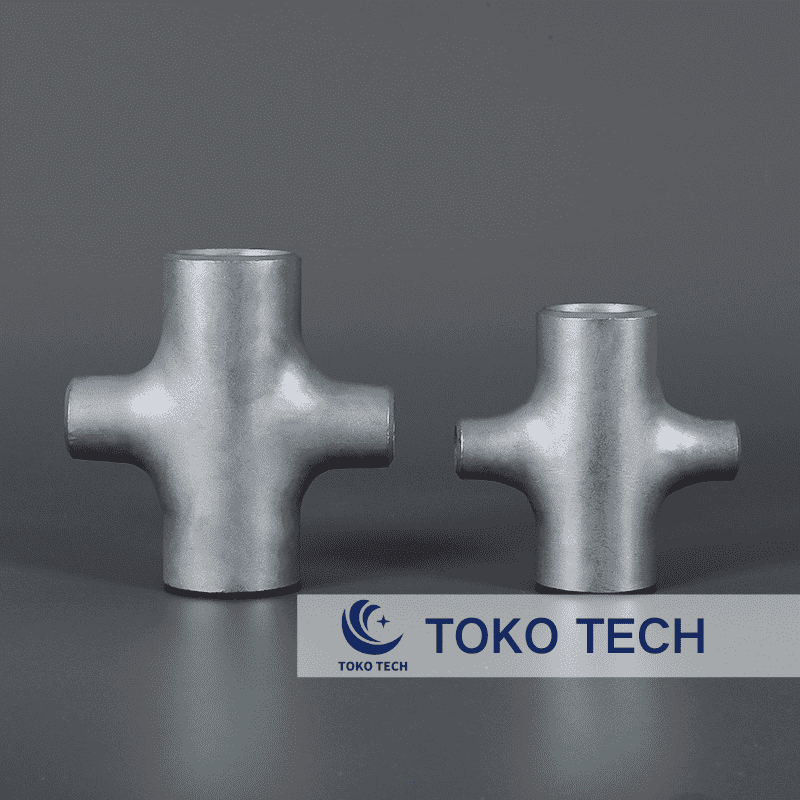
Because our factories are all ISO and PED certificated, and we produce to strict international standards such as ASTM, JIS, DIN, EN, and GOST, TOKO TECH products are deployed across a vast spectrum of heavy industries. Evaluating the specific sector helps illuminate the practical difference between 304 and 316 stainless steel fittings.
- Water Process and Sugar Refining: For standard municipal water processing, clean-in-place (CIP) systems, and sugar refining operations where harsh chlorides are absent, Grade 304 is the industry standard. It provides exceptional hygiene, easy maintenance, and long-term durability without the added cost of molybdenum.
- Oil and Gas, and Petrochemical: In the petrochemical sector, pipelines frequently transport volatile, highly acidic, or caustic media. Here, the difference between 304 and 316 stainless steel fittings becomes a matter of safety. We recommend Grade 316 for handling crude oil sour gas (H2S), sulfuric acid environments, and aggressive solvents.
- Desalination and Geothermal Industry: Desalination plants process high-salinity seawater under immense pressure, while geothermal plants manage highly mineralized, high-temperature steam. Both environments present extreme chloride stress. Grade 316 (or even higher-tier super duplex alloys) is absolutely mandatory, as 304 would succumb to stress corrosion cracking almost immediately.
Cost vs. Benefit Analysis
Procurement departments must weigh initial capital expenditures against total lifecycle costs. A significant difference between 304 and 316 stainless steel fittings is their market price. Because molybdenum is a highly valuable and relatively scarce alloying element, and due to the increased nickel content, Grade 316 is inherently more expensive to produce. On average, a 316 stainless steel fitting will command a premium of 20 to 30 percent over an identical 304 fitting.
However, from our experience, making purchasing decisions based solely on the initial unit price is a profound operational error. If you deploy Grade 304 in a highly corrosive environment to save upfront costs, the financial penalties incurred through premature system failure, unexpected downtime, hazardous material leaks, and emergency replacement labor will vastly eclipse the initial savings. We recommend conducting a thorough environmental audit. If chlorides, marine exposure, or specific industrial acids are present, the higher initial investment in 316 stainless steel is the only economically sound choice.
TOKO TECH: Your Partner in Precision Engineering

At TOKO TECH, we leverage our 11 years of specialized expertise to guide our global clients through complex material selection processes. Whether you require standard fluid transport or high-pressure chemical handling, understanding the difference between 304 and 316 stainless steel fittings is just the beginning. Our extensive manufacturing capabilities allow us to produce perfectly engineered components in both grades to suit your exact specifications.
Our core product line is designed to facilitate seamless integration into any industrial pipeline framework. We proudly manufacture:
- 스테인리스 스틸 크로스 파이프 피팅: Essential for complex junction points where fluid must be distributed in four directions simultaneously. Available in both 304 for standard processing and 316 for aggressive chemical mixing.
- 스테인리스 스틸 감속기(파이프 감속기): Manufactured with absolute precision to manage flow dynamics and pressure changes between differing pipe diameters, ensuring laminar flow and reducing turbulence.
- 스테인리스 스틸 티 피팅: The backbone of fluid distribution networks. Our robust Tee fittings provide leak-proof branch connections, engineered to withstand immense internal pressure.
- 스테인리스 스틸 엘보 파이프 피팅: Utilizing advanced induction bending techniques, our elbows alter fluid direction with minimal friction loss. They are critical components where the difference between 304 and 316 stainless steel fittings dictates the internal erosion and corrosion resistance at the bend apex.
All TOKO TECH products can be produced in standard ASTM, JIS, DIN, EN, and GOST, guaranteeing compatibility with your existing infrastructure regardless of your global location.
Summary Table: Direct Comparison
To provide a clear, scannable reference for your engineering teams, we have compiled the core data regarding the difference between 304 and 316 stainless steel fittings into the responsive matrix below.
| Specification / Feature | Grade 304 Stainless Steel | Grade 316 Stainless Steel |
|---|---|---|
| Chromium Content | 18% | 16% – 18% |
| Nickel Content | 8% | 10% – 14% |
| Molybdenum Content | 0% | 2% – 3% |
| Chloride Resistance | Low (Prone to pitting) | High (Excellent resistance) |
| Marine Suitability | Not Recommended | Highly Recommended |
| Relative Cost | Base Standard | 20% – 30% Premium |
| Primary Industries | Food processing, standard water, architecture | Petrochemical, desalination, marine, pharmaceutical |
자주 묻는 질문(FAQ)
How can I visually tell the difference between 304 and 316 stainless steel fittings?
Visually, there is absolutely no difference between 304 and 316 stainless steel fittings. Both possess the same metallic luster and can be polished or sandblasted to identical finishes. The only way to differentiate them is by checking the material stamp or laser etching applied during manufacturing (e.g., “304” or “316”), or by requesting a Material Test Report (MTR) from the manufacturer. In the field, a positive material identification (PMI) spectrometer gun can be used to analyze the chemical composition instantly.
Is 316 stainless steel harder or stronger than 304?
From a purely mechanical standpoint regarding tensile strength and hardness, the difference between 304 and 316 stainless steel fittings is negligible. Both offer comparable yield strength and structural rigidity. The superior nature of 316 is entirely related to its chemical resistance, not its physical strength.
Can I weld 304 and 316 stainless steel fittings together?
Yes, from our experience at TOKO TECH, it is metallurgically possible to weld 304 and 316 components together. We recommend using a 316L (low carbon) or 309L filler metal for the weld. However, engineers must remember that the overall corrosion resistance of the pipeline will be limited by the weakest link, which in a mixed system would be the 304 components.
What does the “L” mean in 304L or 316L?
The “L” stands for Low Carbon. Grades like 304L and 316L have a maximum carbon content of 0.03 percent, compared to the standard 0.08 percent. This reduction in carbon prevents carbide precipitation during high-temperature welding processes, which further protects the fittings from intergranular corrosion near the weld seams.
Industry References and Standards
To ensure strict compliance with international engineering codes and to further your understanding of the difference between 304 and 316 stainless steel fittings, we recommend consulting the following authoritative standards bodies:
- ASTM International – Standard Specification for Wrought Austenitic Stainless Steel Piping Fittings (ASTM A403)
- American Society of Mechanical Engineers (ASME) – B16.9 Factory-Made Wrought Buttwelding Fittings
- International Organization for Standardization (ISO) – ISO 9001 Quality Management Systems
“`
 Korean
  English
  Spanish
  Russian
  Turkish
  French
  German
  Italian