In the high-stakes world of oil and gas intervention, tube enroulé (CT) has become an indispensable tool. From well cleanouts to hydraulic fracturing, its ability to be deployed continuously under pressure makes it efficient and versatile. However, the immense physical forces, high pressures, and corrosive environments involved require rigorous management. Understanding the ways to control coiled tubing involves looking at both the mechanical operation on the surface and the intrinsic quality control of the metal itself.

Whether you are an operator managing an injector head or a procurement officer sourcing high-end alloy tubes, “control” is the keyword that dictates safety and success. This article explores the five critical methods used to manage, maneuver, and maintain coiled tubing and control lines in modern industrial applications.
Table des matières
1. Mechanical Control via Injector Heads
The primary method of physically manipulating coiled tubing is through the injector head. Unlike jointed pipe, which relies on a drilling rig’s drawworks, coiled tubing is continuous and cannot be rotated. Therefore, the injector head is the sole source of motive force.
Traction and Speed Management
The injector head uses opposing chains of gripper blocks to grab the tubing and push it into or pull it out of the wellbore. Controlling the hydraulic pressure applied to these chains is one of the fundamental ways to control coiled tubing. Operators must balance the “traction pressure” to prevent slipping (which can cause uncontrolled descent) or crushing the tube (which leads to deformation).
Weight Control
The injector also manages the weight-on-bit (WOB). In horizontal wells, the friction drag can be immense. The injector must exert significant snubbing force to push the tubing against the well pressure and friction. Advanced control cabins now utilize automated systems to adjust injector speed and force in real-time, preventing “lock-up” where the tubing can no longer be pushed forward.
2. Pressure Control Systems (PCE)

Controlling the wellbore fluids and gases while the tubing is moving is a critical safety requirement. Since coiled tubing is deployed into live wells, the Pressure Control Equipment (PCE) stack is the primary barrier against blowouts.
Stripper Packers
The first line of defense is the stripper packer (or stuffing box). This device uses hydraulic pressure to energize a rubber element around the tubing, creating a dynamic seal. Controlling the hydraulic pressure on the stripper is vital; too little pressure leads to leaks, while too much pressure accelerates wear on both the element and the tubing.
Blowout Preventers (BOPs)
Beneath the stripper lies the BOP stack. This allows operators to control the well in emergencies. Modern quad-BOPs provide four distinct ways to control the wellbore:
- Blind Rams: Seal the wellbore when no tubing is present.
- Shear Rams: Cut through the tubing in a catastrophic emergency.
- Slip Rams: Grip the tubing to hold it in place.
- Pipe Rams: Seal around the tubing itself.
3. Fatigue Management and Digital Monitoring
Coiled tubing undergoes plastic deformation every time it is spooled off the reel, bent over the gooseneck, and straightened by the injector. This cycle of bending and straightening causes low-cycle fatigue, which is the leading cause of tubing failure.
Real-Time Modeling
One of the most sophisticated ways to control coiled tubing integrity is through fatigue modeling software. Operators input the tubing’s material grade, diameter, and wall thickness. The software tracks every meter of pipe deployed, calculating the accumulated fatigue life. By “controlling” this data, operators know exactly when a string of tubing has reached its safety limit and must be retired, preventing catastrophic downhole failures.
Tube Integrity Monitors
In addition to software, real-time ovality and diameter monitors are often installed on the injector. These sensors detect if the tubing is “ballooning” due to internal pressure or becoming oval due to mechanical stress, providing immediate feedback to the control cabin.
4. Utilizing Control Lines for Downhole Device Operation
While the previous points discuss controlling the large coiled tubing string, the term also encompasses “Control Line Tube.” These are small-diameter hydraulic tubes (often 1/4″ to 3/8″) manufactured from stainless steel or nickel alloys.
These tubes are used to control downhole intelligent completion devices. By pressurizing these lines from the surface, operators can:
- Open and close Surface Controlled Subsurface Safety Valves (SCSSV).
- Operate sliding sleeves to manage production from different zones.
- Inject chemicals directly into the production stream to control scale or corrosion.
In this context, the tubing itself acts as the control mechanism for the entire well system. The reliability of these lines is paramount, as a failure results in the loss of control over downhole safety equipment.
5. Material and Manufacturing Quality Control
Ultimately, the most effective way to control coiled tubing performance is to ensure the raw material and manufacturing processes are flawless. High-pressure and corrosive environments demand superior metallurgy. Poor quality steel leads to premature fatigue, corrosion cracking, and operational hazards.
Controlling the alloy composition (e.g., using high-nickel alloys for sour gas wells) and ensuring precise wall thickness during manufacturing provides the foundational reliability required for the field.
TOKO TECH: Excellence in Pipeline Manufacturing
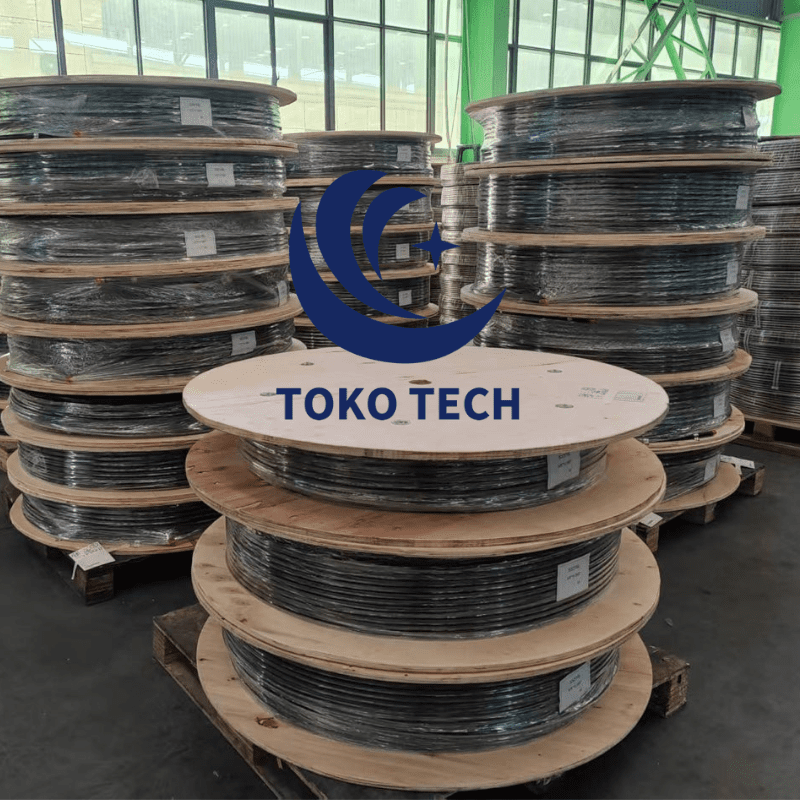
TOKO TECH is an export-driven manufacturing enterprise specializing in the R&D, production, and sales of high-end metal pipeline systems. Headquartered in Shanghai, China, with manufacturing facilities located in the Yangtze River Delta—China’s industrial core region—the company operates a modern production base. Since its establishment, TOKO TECH has adhered to the core philosophy of “Quality First, Innovation Driven”, dedicated to providing high-performance, corrosion-resistant, and high-temperature/high-pressure pipeline products for global clients.
These products are widely used in industries such as petrochemicals, energy and power, shipbuilding, pharmaceutical and food processing, and environmental engineering. By implementing rigorous quality control standards, TOKO TECH ensures every reel of tubing delivers maximum performance.
Our Products:
- Tube sans soudure
- Tubes et tuyaux soudés
- Raccord de tuyauterie en acier inoxydable
- Tubes enroulés/Tubes pour lignes de contrôle
- Tube sans soudure en alliage de nickel
- Barre/tige en alliage de nickel
Summary Table: Methods of Control
| Control Method | Primary Equipment | Objective |
|---|---|---|
| Mechanical | Injector Head | Manage speed, depth, and weight-on-bit. |
| Pressure | BOPs, Stripper Packers | Contain wellbore fluids and prevent blowouts. |
| Life Cycle | Fatigue Software | Monitor plastic deformation and retire tubing before failure. |
| Functional | Hydraulic Control Lines | Operate downhole valves and safety devices. |
| Quality | Manufacturing QA/QC | Ensure metallurgical integrity and corrosion resistance. |
Questions fréquemment posées
What is the difference between Coiled Tubing and Control Line Tube?
Coiled tubing generally refers to larger diameter (1″ to 3″) continuous pipes used for well intervention services like cleaning or drilling. Control Line Tube refers to smaller diameter (1/8″ to 5/8″) tubing that is installed permanently to operate downhole valves or inject chemicals.
How do you prevent coiled tubing from buckling?
Buckling is controlled by managing the injector speed and the unsupported length of the tubing. Operators rely on software simulations to determine the maximum “weight” that can be applied before the tubing helically buckles and locks up inside the casing.
Why is nickel alloy used in control lines?
Nickel alloys (like Alloy 825 or 625) are used to control corrosion. In deep, hot wells with high concentrations of Hydrogen Sulfide (H2S) or CO2, standard stainless steel can fail rapidly. Nickel alloys provide the necessary resistance to these harsh environments.
What is a stripper packer?
A stripper packer is a dynamic seal located on top of the wellhead. It allows the coiled tubing to move in and out of the well while containing the well’s pressure, ensuring no fluids escape into the atmosphere.
 French
  English
  Spanish
  Russian
  Turkish
  Korean
  German
  Italian