In the complex landscape of global industrial infrastructure, the materials and methods chosen for fluid, gas, and data transmission directly dictate the operational success and safety of a project. Historically, industrial piping relied heavily on traditional straight-length stick tubing. While functional, this method introduces inherent vulnerabilities, primarily through the necessity of numerous mechanical fittings and orbital welds. As engineering demands have evolved to require greater performance in harsher environments, a critical shift has occurred toward continuous pipeline solutions. Understanding the myriad benefits of gewickelte Rohre is essential for any procurement engineer or project manager looking to optimize system integrity and reduce long-term operational costs.
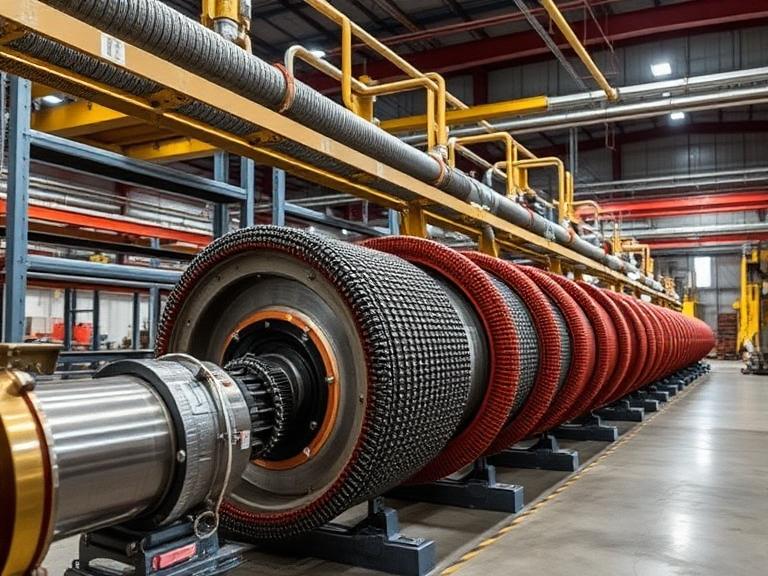
At TOKO TECH, we have positioned ourselves as an export-driven manufacturing enterprise specializing in the R&D, production, and sales of high-end metal pipeline systems. Headquartered in Shanghai, China, with manufacturing facilities located in the Yangtze River Delta—China’s industrial core region—we operate a strictly modernized production base. From our experience supplying major global energy projects, the transition from stick tubing to continuous formats is not merely a trend; it is a fundamental engineering upgrade. We have adhered to our core philosophy of Quality First, Innovation Driven, dedicating our resources to providing high-performance, corrosion-resistant, and high-temperature/high-pressure pipeline products for global clients. In this authoritative technical guide, we will analyze the exact operational and financial benefits of coiled tubing, demonstrating why it has become the standard for critical applications worldwide.
Inhaltsübersicht
- Summary Table: Core Advantages of Continuous Tubing
- 1. Elimination of Mechanical Joints and Welds
- 2. Rapid Installation and Deployment
- 3. Superior Safety and Leak Prevention
- 4. Enhanced Corrosion Resistance in Harsh Environments
- 5. Unmatched Cost Efficiency Over the Project Lifecycle
- 6. Unrivaled Versatility Across Diverse Industries
- Expert Buying Guide: Selecting the Right Tubing
- Häufig gestellte Fragen (FAQs)
- Industry References
Summary Table: Core Advantages of Continuous Tubing
To provide an immediate technical overview for project engineers, we have compiled a summary table detailing the primary benefits of coiled tubing. We recommend utilizing this matrix when comparing continuous tubing options against traditional straight-length pipe procurement.
| Engineering Aspect | Traditional Stick Tubing | Continuous Coiled Tubing | Primary Operational Advantage |
|---|---|---|---|
| System Integrity | Requires joints every 6 to 12 meters | Thousands of meters without a single joint | Eliminates primary points of structural failure |
| Installation Speed | High labor hours for welding and fitting | Rapid spooling and unspooling | Drastically reduces project downtime |
| Leak Potential | High risk at every connection point | Virtually zero risk along the continuous run | Ensures extreme safety for hazardous fluids |
| Corrosion Management | Welds introduce metallurgical vulnerabilities | Uniform metallurgical structure | Maximizes lifespan in harsh chemical environments |
| Inspection Costs | Expensive NDT (Non-Destructive Testing) per weld | Minimal NDT required post-installation | Significant reduction in QA/QC labor costs |
| Flexibility | Rigid, requiring elbow fittings for turns | Naturally accommodates sweeping bends | Optimizes fluid flow by reducing friction loss |
1. Elimination of Mechanical Joints and Welds
When analyzing the mechanical architecture of any pipeline system, the weakest points are invariably the connections. Traditional straight piping, typically supplied in 20-foot or 40-foot lengths, requires a massive number of orbital welds or mechanical compression fittings to cover long distances. One of the most significant benefits of coiled tubing is its continuous nature. Manufacturers can produce spools containing thousands of meters of uninterrupted tubing.
From our experience at TOKO TECH, eliminating these joints fundamentally changes the reliability profile of a system. Every weld introduces a heat-affected zone (HAZ) where the metallurgical structure of the alloy is altered, making it highly susceptible to localized corrosion and stress cracking. By utilizing a continuous spool, engineers bypass this vulnerability entirely. The fluid or gas travels through a uniform, uninterrupted internal surface, which not only preserves structural integrity but also significantly improves flow dynamics by eliminating the turbulence created by internal weld beads and fitting transitions.
2. Rapid Installation and Deployment
In large-scale industrial projects, time is a critical financial metric. The labor required to install traditional piping is immense. Fitters must measure, cut, prep, align, and weld every single joint, after which quality assurance teams must perform exhaustive Zerstörungsfreie Prüfung (NDT) such as X-ray or ultrasonic inspection on each weld. A primary factor contributing to the overall benefits of coiled tubing is the sheer speed of deployment.
Continuous tubing is delivered on large wooden or metal spools. Installation teams simply unspool the required length, route it through the facility or down the wellbore, and make only two connections: one at the source and one at the destination. We recommend this approach particularly for offshore platforms, subsea umbilicals, and complex petrochemical routing where minimizing hot work (welding) and reducing personnel hours on-site are paramount safety and financial objectives.
3. Superior Safety and Leak Prevention
When dealing with highly toxic, flammable, or pressurized media, a leak is not merely a maintenance issue; it is a catastrophic safety and environmental hazard. The correlation between the number of fittings in a system and the probability of a leak is absolute. Therefore, one of the most vital benefits of coiled tubing is its inherent leak prevention capabilities.
Because there are no intermediate connections, the pathway for fugitive emissions is eradicated. The tubing acts as a continuous containment vessel. In industries such as petrochemical processing and nuclear energy, where regulatory agencies impose strict limits on emissions, continuous tubing guarantees compliance. The metallurgical uniformity ensures that pressure containment remains consistent across the entire length of the run, providing operators with absolute confidence in their system infrastructure.
4. Enhanced Corrosion Resistance in Harsh Environments
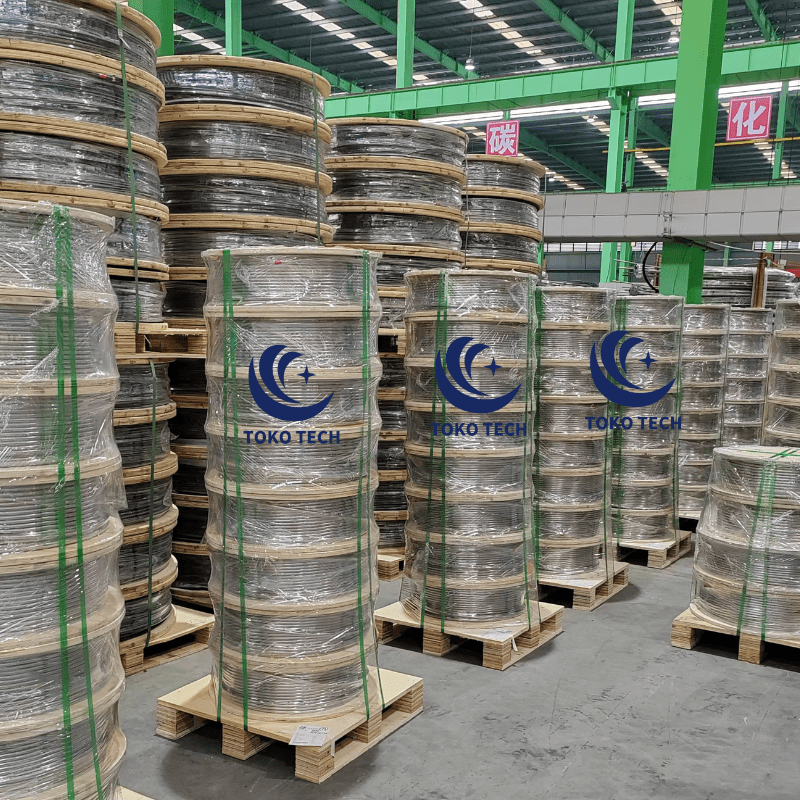
The environments in which these pipelines operate are often unforgiving, featuring highly acidic compounds, extreme temperatures, and heavy chloride exposure. To maximize the benefits of coiled tubing, the correct metallurgical alloy must be selected. At TOKO TECH, our production base in the Yangtze River Delta utilizes advanced manufacturing techniques to produce tubing capable of surviving the most aggressive conditions on earth.
For standard marine and chemical applications, we recommend our UNS S31603 / EN 1.4404 / ASTM A269 TP316L Geschweißte Rohrschlangen. This specific grade provides excellent resistance to pitting and crevice corrosion in chloride environments. However, for applications involving extreme heat and severe oxidation, our UNS N06600 / EN 2.4816 / ASTM B167 / W. Nr. 2.4816 (Inconel 600) Welded Coiled Tubing is the superior choice, maintaining its structural integrity at elevated temperatures.
Furthermore, in environments containing sour gas (hydrogen sulfide) or heavy acid concentrations, the ultimate solution is our UNS N10276 / EN 2.4819 / ASTM B622 / W. Nr. 2.4819 (Hastelloy C-276) Seamless Coiled Tubing. Producing this as a seamless product further amplifies the benefits of coiled tubing, offering unparalleled resistance to localized corrosion and stress corrosion cracking.
5. Unmatched Cost Efficiency Over the Project Lifecycle
A common misconception in procurement is evaluating materials solely on their initial per-meter cost. While advanced alloys in continuous spools may carry a higher initial material price than standard carbon steel stick pipe, the lifecycle benefits of coiled tubing present overwhelming cost efficiency. The true cost of a pipeline system includes material, installation labor, inspection, maintenance, and facility downtime.
From our experience, the reduction in labor hours for welding and the virtual elimination of NDT inspection costs often offset the premium material price before the system is even commissioned. Over the operational life of the asset, the lack of maintenance required for leaking joints and the extended lifespan provided by high-grade alloys like Hastelloy C-276 and Inconel 600 mean the total cost of ownership is drastically lower. We strongly advise project managers to calculate total installed cost when evaluating pipeline architecture.
6. Unrivaled Versatility Across Diverse Industries
The final pillar establishing the dominance of this technology is its adaptability. The benefits of coiled tubing are not restricted to a single sector. Because the tubing can be manufactured in various outer diameters, wall thicknesses, and alloy grades, it serves a vast array of critical functions globally.
At TOKO TECH, our products are widely used in industries such as petrochemicals, energy and power, shipbuilding, pharmaceutical and food processing, and environmental engineering. Beyond single fluid lines, we also manufacture highly specialized Multi-core Tubing. This product encases multiple continuous tubes—often alongside electrical or fiber optic cables—within a single protective outer jacket. This is extensively utilized in subsea control umbilicals and complex hydraulic control panels, proving that the continuous format can be engineered to solve nearly any transmission challenge.
Expert Insight from TOKO TECH: The decision to utilize continuous tubing fundamentally reduces operational risk. By eliminating hundreds of potential failure points (welds) and selecting the precise alloy for your chemical environment, you ensure that your facility operates with maximum uptime and safety compliance.
Expert Buying Guide: Selecting the Right Tubing
To fully leverage the benefits of coiled tubing, procurement engineers must clearly define their operational parameters before engaging a manufacturer. We recommend the following evaluation process:
- Determine the Chemical Environment: Identify the exact fluids or gases being transported, their concentrations, and the presence of chlorides or sour gas. This dictates whether a standard TP316L alloy is sufficient or if an extreme environment alloy like Hastelloy C-276 is required.
- Analyze Pressure and Temperature: Calculate the maximum allowable working pressure (MAWP) and peak operating temperatures. This will define the necessary wall thickness and whether a high-temperature alloy like Inconel 600 is necessary.
- Seamless vs. Welded: Understand the application limits. While high-quality welded continuous tubing (which undergoes rigorous drawing and annealing) is excellent for most applications, ultra-high pressure or extremely corrosive environments may mandate a seamless drawing process.
- Verify Manufacturing Standards: Ensure the manufacturer strictly adheres to global standards such as ASTM, ASME, and EN. At TOKO TECH, our commitment to Quality First guarantees that every spool leaving our Yangtze River Delta facility is fully certified and traceable.
Häufig gestellte Fragen (FAQs)
What is the maximum continuous length available for these spools?
Depending on the outer diameter and wall thickness of the tubing, spools can be manufactured in continuous lengths ranging from several hundred meters up to several kilometers. We recommend consulting directly with our engineering team to determine the maximum spool capacity for your specific dimensions to maximize the benefits of coiled tubing on your site.
How is continuous tubing transported to the job site?
The tubing is carefully wound onto heavy-duty wooden or steel spools at our manufacturing base. These spools are then secured in standard shipping containers or specialized flat rack containers for global ocean or rail freight, ensuring the tubing remains perfectly round and undamaged during transit.
What is Multi-core Tubing used for?
Multi-core Tubing bundles several continuous tubes and control cables together into one single umbilical line. From our experience, this is the most efficient way to route hydraulic fluids, chemical injection lines, and electrical signals simultaneously to remote subsea valves or complex offshore platforms.
Does coiled tubing suffer from deformation when unspooled?
No. High-end metal pipeline systems are precisely annealed during the manufacturing process. This thermal treatment relieves internal stresses, ensuring that the alloy retains the necessary ductility to be spooled and subsequently straightened during installation without suffering from work hardening or ovality issues.
Industry References
- American Society for Testing and Materials (ASTM) – Standards for Stainless Steel and Nickel Alloy Tubing (ASTM A269, B167, B622). View ASTM Standards
- American Society of Mechanical Engineers (ASME) – Boiler and Pressure Vessel Code for Pipeline Integrity. View ASME Guidelines
 German
  English
  Spanish
  Russian
  Turkish
  French
  Korean
  Italian