In the high-stakes sectors of modern industry, the integrity of a pipeline system is non-negotiable. Whether transporting volatile petrochemicals, facilitating energy and power generation, or supporting environmental engineering projects, the infrastructure relies entirely on the strength of its metallurgical bonds. A single flaw in a pipe welded joint can lead to catastrophic failures, environmental hazards, and immense financial losses. Therefore, understanding the rigorous science and methodology behind how a pipe welded section is created is paramount for engineers, procurement specialists, and project managers alike.
As an export-driven manufacturing enterprise specializing in the R&D, production, and sales of high-end metal pipeline systems, TOKO TECH is deeply embedded in this intricate process. Headquartered in Shanghai, China, with advanced manufacturing facilities located in the Yangtze River Delta—China’s industrial core region—our modern production base represents the pinnacle of current welding technology. Since our establishment, TOKO TECH has adhered strictly to the core philosophy of “Quality First, Innovation Driven”. We are dedicated to providing high-performance, corrosion-resistant, and high-temperature/high-pressure pipeline products for global clients.
In this comprehensive guide, we will dissect the mechanical and thermal processes involved when a pipe welded joint is formed, contrasting manufacturing methodologies with field-welding techniques, and exploring the strict quality controls required for global industrial compliance.
- 1. The Fundamentals of Pipe Welding Technology
- 2. Factory Manufacturing: How Is a Pipe Welded in Production?
- 3. Field Welding and Fitting Connections
- 4. Seamless vs. Welded Pipeline Systems
- 5. High-Performance Material Considerations
- 6. Quality Control and Non-Destructive Testing
- 7. Summary Comparison Table
- 8. Frequently Asked Questions
- 9. Referenzen
1. The Fundamentals of Pipe Welding Technology
To accurately answer how is a pipe welded, one must first recognize that welding is not merely melting two pieces of metal together. It is a complex metallurgical process that permanently joins metals by establishing localized coalescence. This is achieved through the precise application of heat, pressure, and often a filler metal. When a pipe welded joint cools, the resulting molecular structure in the Heat Affected Zone (HAZ) must possess mechanical properties—such as tensile strength, yield strength, and impact toughness—that match or exceed those of the base pipe material.
From our experience in the pharmaceutical and food processing industries, as well as shipbuilding, the methodology chosen to create a pipe welded connection dictates the internal smoothness, corrosion resistance, and pressure tolerance of the final system. The process begins long before the welding arc is struck; it requires strict material selection, precise edge preparation, and rigorous atmospheric control to prevent oxidation.
2. Factory Manufacturing: How Is a Pipe Welded in Production?
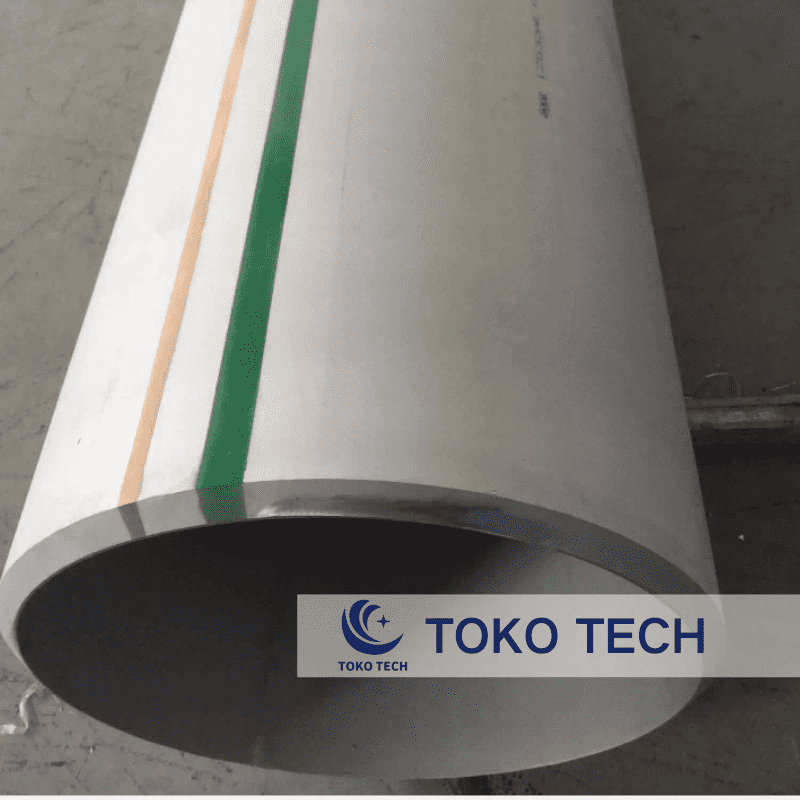
In a controlled factory environment like our production base in the Yangtze River Delta, raw steel coils or heavy plates are transformed into cylindrical forms and sealed. The primary methods used to create industrial Geschweißte Rohre/Rohre include Electric Resistance Welding (ERW), Longitudinal Submerged Arc Welding (LSAW), and Spiral Submerged Arc Welding (SSAW).
Electric Resistance Welding (ERW)
In the ERW process, a flat strip of steel is fed through a series of forming rollers that gradually cold-form it into a cylindrical shape. Once the edges meet, a high-frequency electrical current is passed through the steel. The natural electrical resistance of the metal edges generates intense heat, bringing the steel to a forging temperature. Pressure is then applied by squeeze rolls to forge the edges together without the use of any filler metal. A pipe welded via the ERW process is known for its high production efficiency and excellent dimensional accuracy. After welding, the weld seam undergoes localized heat treatment to normalize the grain structure, ensuring the pipe welded seam is as strong as the parent metal.
Longitudinal Submerged Arc Welding (LSAW)
For applications requiring thick-walled pipes capable of withstanding extreme high-temperature and high-pressure environments, LSAW is the preferred method. Here, heavy steel plates are pressed into a U-shape and then an O-shape (the UOE forming process). The edges are then welded inside and out using a submerged arc welding process. In this technique, the welding arc operates beneath a blanket of granular flux, which prevents atmospheric contamination, stabilizes the arc, and slows the cooling rate to improve the metallurgical properties of the pipe welded joint.
Spiral Submerged Arc Welding (SSAW)
SSAW involves forming a steel strip into a spiral shape and welding the helical seam using the submerged arc method. This allows for the production of very large diameter pipes from standard-width steel coils. While highly efficient for water transmission and foundational piling, a pipe welded using SSAW is generally subjected to less extreme pressure limits compared to LSAW.
3. Field Welding and Fitting Connections
While longitudinal seams are welded in a factory, joining individual sections of pipe or attaching a Stainless Steel Pipe Fitting in the field requires manual or semi-automated circumferential welding. The success of a pipe welded in the field relies heavily on the skill of the operator and the exactness of the procedure.
The Step-by-Step Procedure
- Preparation and Beveling: The ends of the pipe must be machined to a specific angle (usually 30 to 37.5 degrees) to create a V-groove. This geometry allows the welding arc to penetrate fully to the inner wall of the pipe.
- Alignment and Fit-Up: The pipes are clamped together with a highly specific gap (the root opening). From our experience, poor alignment is the leading cause of a rejected pipe welded joint.
- The Root Pass: This is the most critical stage. The welder deposits the first layer of filler metal, bridging the gap and fusing the inner edges. A flawless root pass ensures a smooth internal bore, which is crucial in preventing turbulent fluid flow and localized corrosion.
- Hot Pass and Fill Passes: Subsequent layers of weld metal are applied to clean out impurities from the root pass and build up the thickness of the joint.
- The Cap Pass: The final layer creates a slight reinforcement over the outer surface of the pipe, providing structural completion and aesthetic uniformity to the pipe welded connection.
For high-end applications, Tungsten Inert Gas (TIG) welding is frequently used for the root pass to ensure ultimate purity, followed by Shielded Metal Arc Welding (SMAW) or Gas Tungsten Arc Welding (GTAW) for the fill and cap passes.
4. Seamless vs. Welded Pipeline Systems
A frequent point of discussion among our global clients is the choice between a Nahtlose Rohre/Rohre and a welded alternative. Historically, seamless pipes were considered vastly superior for high-pressure applications because they lack a longitudinal weld seam, eliminating a potential point of failure.
However, modern advancements in non-destructive testing and metallurgy have closed this gap significantly. A high-quality pipe welded in a state-of-the-art facility can perform comparably to seamless pipes in many petrochemical and energy sectors, often offering tighter dimensional tolerances and a more uniform wall thickness. Nevertheless, for the absolute most critical environments, such as deep-water offshore drilling or highly corrosive downhole operations, we still supply premium seamless solutions, including specialized Gewickelte Rohre/Steuerleitungsrohre systems.
We recommend conducting a thorough cost-benefit analysis based on your specific pressure, temperature, and corrosive media parameters when deciding whether a pipe welded system or a seamless system is appropriate for your project.
5. High-Performance Material Considerations
The methodology of how a pipe welded joint is formed changes dramatically when dealing with advanced alloys. Standard carbon steel behaves very differently under a welding arc compared to stainless steels or nickel alloys. At TOKO TECH, we specialize in high-end metallurgy.
When working with a Nickel Alloy Seamless Pipe/Tube or welding components crafted from a Nickel Alloy Bar/Rod, heat input must be strictly controlled. Nickel alloys are highly susceptible to hot cracking if the heat input is too high or if sulfur and phosphorus contaminants are present. The welding area must be surgically clean, and specialized shielding gases (such as pure argon or argon-helium mixtures) must be utilized to protect the molten weld pool.
From our experience, we recommend using filler metals that are slightly over-alloyed compared to the base metal when a pipe welded joint is created in highly corrosive environments. This compensates for any elemental segregation that occurs during the rapid cooling of the weld pool, ensuring the pipe welded seam maintains the same corrosion resistance as the rest of the pipeline system.
6. Quality Control and Non-Destructive Testing
A pipe welded is only as reliable as the testing used to verify it. To uphold our philosophy of “Quality First,” rigorous Non-Destructive Testing (NDT) is implemented across all our product lines.
- Radiographic Testing (X-Ray): Used to detect internal flaws such as porosity, slag inclusions, or lack of fusion within the pipe welded seam.
- Ultrasonic Testing (UT): High-frequency sound waves are transmitted into the metal. Reflections indicate cracks or inconsistencies deep within the wall thickness.
- Hydrostatische Prüfung: The completed pipe welded section is sealed and filled with water under extreme pressure to verify it can withstand operational stresses without bursting or leaking.
- Wirbelstromprüfung: Excellent for detecting surface and near-surface defects in conductive materials.
7. Summary Comparison Table
To assist our clients in understanding the manufacturing distinctions, we have provided a technical summary comparing the primary pipe production methods.
| Manufacturing Method | Process Characteristics | Typical Wall Thickness | Primary Industry Applications |
|---|---|---|---|
| ERW (Electric Resistance Welding) | High-frequency current, no filler metal, high efficiency. | Light to Medium | Water transmission, structural support, low-pressure fluids. |
| LSAW (Longitudinal Submerged Arc) | UOE forming, submerged arc with filler, stress-relieved. | Medium to Heavy | High-pressure petrochemical, offshore platforms. |
| SSAW (Spiral Submerged Arc) | Helical seam, flexible diameter production. | Mittel | Large diameter water/gas lines, foundational piling. |
| Seamless Extrusion | Pierced solid billet, no weld seam. | All Thicknesses | Critical high-temperature/high-pressure environments, control lines. |
8. Frequently Asked Questions
What is the most common reason a pipe welded joint fails?
Failures typically originate from improper fit-up and alignment prior to welding, lack of penetration during the root pass, or failure to properly control heat input, which can lead to brittle microstructures in the heat-affected zone.
Can a pipe welded system be used in high-pressure petrochemical plants?
Yes. Heavy-wall pipes manufactured via the LSAW process, combined with rigorous NDT and proper heat treatment, are routinely specified for high-pressure applications globally.
Why is argon gas used when welding stainless steel or nickel alloys?
Argon is an inert gas. It surrounds the welding arc and the molten weld pool, displacing atmospheric oxygen and nitrogen. This prevents the metal from oxidizing and ensures a pure, strong, and corrosion-resistant pipe welded joint.
Does TOKO TECH provide customized pipeline solutions?
Absolutely. Operating from the Yangtze River Delta, our facility is equipped to handle custom requirements, providing specialized pipeline systems, including advanced nickel alloy solutions, tailored to the specific environmental and pressure constraints of your project.
 German
  English
  Spanish
  Russian
  Turkish
  French
  Korean
  Italian